I voted this October 19 Monday to do my bit for democracy. And bring in a new government for the country. I did it at our Town Hall which, for 140 years, remains a vital heart of our little community. Built in 1875 for the grand sum of $4000, it has hosted every sort of event imaginable. Dances, dinners, showers, meetings, concerts, lectures, amateur shows, receptions, theatricals, debates, strawberry socials, etc., etc. Generations of nervous school children, including myself, have trod the boards, reciting and caroling at their Christmas concerts. The highlight of my own career was starring as Mrs. Green in Mrs. Greens Goodwill when I was in grade six. And we little tykes could cram ourselves into the deep window wells as the best place to watch the antics of the grown ups.
A packed Hall in former days with the stoves at the back.
Our Hall changed with the times. The long buggy shed at the back has been replaced with a base for our volunteer fire department trucks. The four hole outhouse toilet has given way to modern sanitation and the kitchen has all the conveniences. The two stoves at the back, with pipes running the length of the Hall are replaced by up to date heating. Folding chairs take the place of the long wooden benches that had to be so laboriously unstacked for use. Somewhere along the way, the modernizers also pulled out the beautiful proscenium arch stage, so permeated with history, and replaced it with an incongruous platform. Useful but not right.
Today we come to vote in cars and combines. But vote we do!
The unusual size of the place attests to ambitions of the builders who expected the village to grow into a thriving town that would need the space. Well, the place shrank instead but the Hall remains the central hub. Where once buggies crowded the front, today cars pull up continuously as the neighbourhood casts it vote. If we have a one single duty to this splendid country we live it, it is to think and vote. Parties in power tend to have a ten year cycle before they become too entrenched and arrogant. Then they need a good time out to clean house and refresh themselves. So we chucked the rulers out and replaced them with a shiny new prime minister and a party rejuvenated from near death at the previous election.
Once again the Hall did its job. Hope they’re still voting and dancing inside it’s walls a hundred years from now.
According to the List of Old English professions, I am an agister: a person who affords pasture to the livestock of others for a price. (e.g. cattle, pigs, sheep, ponies, horses) Can also refer to forest pasturage or herbage.
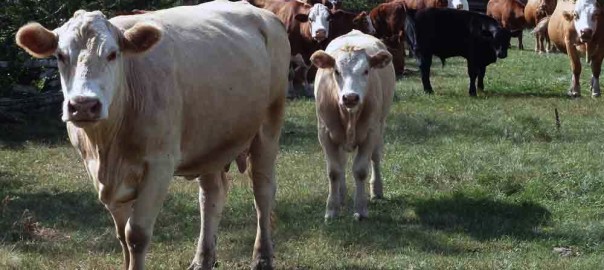
Glad to know I belong to an ancient tradition. My fields are full of cattle who graze and doze and swish flies all summer, then go home to their nice warm barn when the weather turns. I keep a fierce but invisible bull to scare off fence breaking birders and would be hunters. The visible herd all placid cows tending their young.
Nothing out there is slated to become a burger, at least not yet. My cattle are from a cow calf operation. The cows arrive with their babies and raise them all summer. By the fall, the calves are hulking teenagers ready for sale. The farmers who buy them will raise the heifers to calf-producing adulthood. The young steers, sleek and plump, can look forward to burgerdom next fall. The cows in my pasture already carry the calf they will bring back next spring.
If I were in Ye Olde England, I, the cowherder, would have use for a cow leech (early veteranarian) and an ankle beater (young person to help drive the cattle to market). I might sell to a cowkeeper who needed a cow to keep behind her city house so she could sell the milk from her window each morning. More than one cow might require a dey wife (female dairy worker).
Katie, a character in my historical novel, The Tomorrow Country, had probably never met a cow up close, she lived in such a poor, overcrowded part of East End London. Other Home children rescued from such conditions and sent to farms in Canada, had to conquer quaking terror of large farm animals they had never seen before.
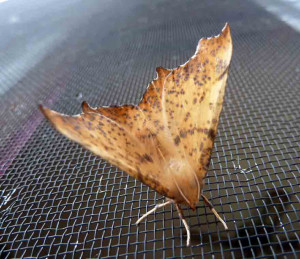
It just showed up, clinging to the screen, still quite alive but not willing to move. I took its picture, from several directions. It ignored me, grimly hanging on. I have no idea what its name is. I may never have seen one before. However, I admired it, for its lovely rich browns and it’s clever ploy of looking very like a leaf.
It’s disguise worked well for about half a day. Yet, in a world of yellow, green, brown, scarlet leaves flying about, it could not fool everyone. I glanced up to see a bird doing an acrobatic hover up against the glass as though it wanted to come in. It only wanted the visitor and gulped it down before my eyes.
As the bird smugly zoomed off, I thought of all the insects out there, doomed by the cold to a quick or slow demise. The mosquitoes have long gone. The once deafening chorus of crickets is reduced to a few hardy outliers. Beetles who thought themselves safe in my woodpile run for it when I lift the blocks.
The first hard frost must come to the insect world the way the asteroid brought mass extermination to the dinosaurs. Stilled bodies everywhere with their sad little feet in the air. Oh well. The woodpile is also full of fuzzy egg sacs holding the hopes of their kind for spring.
It’s been a year now since our village bridge was replaced.
Our old bridge. Cracking underneath. Time to go.
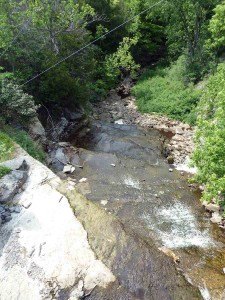
The work closed our road nearly all summer, requiring a roundabout detour to get to town or to the village. We watched with interest as the creek was diverted into a temporary culvert and the old bridge, dating far beyond my childhood, was broken up and removed. It had cracked underneath, making it weaker and dangerous. We saw the bridge approaches altered, the wide new cement arches put in, the road filled in around them the railings erected.
Gone were the rusty piping that had kept me from falling into the water as I checked out the foaming stream daily on my way to school. Shiny metal traffic barriers lead to low, patterned concrete walls topped with a single rail, the elegance of lighting just for the bridge and even provision for decorative banners for village events. Below, the historic mill stone wall was carefully preserved.
The creek tumbles on. We can look at it over fine new railing instead of rusty pipe.
The whole was finished off with velvet smooth fresh a pavement which now extends not just over the bridge but a whole mile or more toward my home. Drive or bike on it and you just float. Ah the joys of brand new asphalt. With potholes far in the future.
One year later, we are all still mightily pleased with our new crossing place. Tiny in the country’s infrastructure, massive to us. Thanks county engineers for lots of back and forth for the next fifty years.
Those pitiful tides of refugees begging asylum all had homes and a country of their own before they had to flee for their lives. Forced out by ruthless male violence.
Though certainly women may be involved, the vast majority of the world’s brutality is caused by men. I’m not talking about the millions upon millions of kind, peaceful, honourable men who lovingly care for their families and work hard to contribute for the betterment of all.
I’m talking about the other kind.
The kind that start wars, invade their neighbours, exploit, steal, rape, torture, murder and lay waste with gleeful enthusiasm. For thousands of years male violence had been humanity’s single main problem. Violence against each other, violence against women and children, against the environment, culture, the economy, etc. Think of those greedy, unpunished fellows who so recently pillaged our financial system, not caring a fig how much poverty and distress they spread around the globe.
Nor can outbreaks of violence be blamed on a single psycho nut leader. Hitler did not ravage Europe all by himself. He had thousands of enthusiastic accomplices more than willing to bomb cities flat, run concentration camps, toss babies into furnaces and grind helpless populations under the tracks of their tanks. In the face of such aggression, masses of peaceful males are forced to become violent themselves in order to defend their homes. In World War II, I’ve heard that 80% of the Russian men born in 1923 did not survive Hitler’s invasion. I’m sure most of them would rather have been planting potatoes or singing drinking songs rather than frantically rushing into the bloody, last ditch battle to save their families and their homeland.
Trying to keep down male violence is a never ending game of Whack-A-Mole with the odds against us. A glance at history is mostly a tale of wars. The ancient books of the Bible, all about guys, contain invasion and destruction from one end to the other. Squelch one trouble spot and another one springs up around the corner, endlessly devouring resources that should be used to build housing, save wetlands or see that every child has schooling and enough to eat.
Look at any failed state or region today where folks have finally managed to oust their nasty dictator. Do they grab the opportunity to form peaceful, all inclusive committees that plan the most beneficial government for all? No, they grab guns, sprout gangs, militias and warlords. start shooting each other and terrorizing the weakest among them. Any chance at peace dies in the fever to fight for power and exploit the unprotected.
Violence and devastation begets more violence and devastation, creating cycles that make peace on Earth a pallid fantasy. It is pretty clear that the violence will continue until these fellows manage, one way or another, to run the whole planet into ruin. Male violence, after all, created the ranks of nuclear weapons still sitting temptingly at hand, fully armed and pointed at our heads.
Time to stop lamenting that “boys will be boys” and do something about the problem at the source.
Suppose we take a few billion out of defense budgets and use the money to study violent human males right down to the DNA level until we find out WHAT THE F*** IS WRONG WITH THEM!
Suppose we treat male violence as the deadliest disease we have ever had to face and rise to the challenge of wiping it out. This is not a frivolous idea. Today we have enormous scientific resources at our fingertips. Why not use them to go after male violence the way we went after, and beat, small pox, TB and polio?
Let’s discover what makes it possible for them to deliberately starve and bomb whole populations, carry out death squad assassinations, rape and murder screaming women and children, poison land and water, try to kill the last rhino, scheme to subvert decent governments, drag people into slavery, run vicious drug cartels, create those kill or we’ll kill you traps that keep the military swelled and force everyone, peaceful or not, to become violent.
We can unearth the answer if we are determined enough. Maybe it is some rogue gene that needs removing. Or a particularly horrific mental illness infecting mind and body. Perhaps a brain deformity that prevents compassion and should no longer be passed to new generations. Maybe we can come up with an anti-violence vaccine to be administered as a matter of course along with the diphtheria, polio and whooping cough jabs. It might be as simple as a critical nutritional deficiency. Who knows!
Whatever makes violent menfolk so monstrously deranged, we must root out the cause and find a way to heal the sickness. Then we’ll have a chance at a stable, sustainable, happy existence for all Earth’s children. We could probably do it in a week once we got our hands on the vast resources no longer sucked up by worldwide military spending.
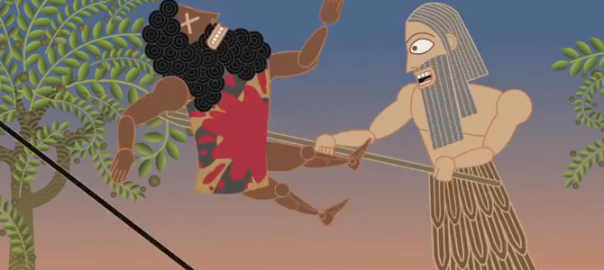
Though this Nina Paley video is about the Middle East, it serves as a capsule history of just about everywhere else guys have taken to bashing each other.
Prince Edward County had a farming heyday in the 19th century, a period when the great wooden barns were raised, the ones with the massive axe hewn beams held together with wooden pegs and builder’s skill. The whole neighbourhood flocked to the barn raising. Squads of men sweated until each section rose vertically to be pegged together to the others by the foreman padding about fearless high above the ground. Up went long poles to support the roofing, more poles to floor the hay mows, board sheathing to cover the sides and keep out the weather. On went the huge double doors to let the hay wagons through.
The women laid on masses of food for the famished crew. Mashed potatoes, dumplings, chicken pot pie, smoked ham, pickles, cabbage salad, steaming carrots and turnips, pickles, pitchers of cold well water, cream and milk. And for afters, apple, cherry, raisin, mince, custard pies, pound cake, marble cake, spice cake, pots of tea and coffee. The men sloshed the dust from themselves at the well and dug in.
When dusk fell and chores were done, out came the fiddles. Those who had laboured all day, danced reels and square dances and waltzes into the night dances while their over excited children fell asleep in soft piles of hay.
Those barns still stand a 100, 150, nearly 200 years later, the beams that had been so carefully chosen, shaped and seasoned, still as good and the day they were put up. Good for another two hundred years.
Good, that is, if the roof has been kept in repair, the leaks kept out, the rain prevented from pouring in carrying its deadly cargo of rot. All over the county these old barns, which so often had little use any more, are left to collapse from neglect. Their beams decay, their roofs and sides gape open to the weather, the November winds bash at them until they give and fall down.
Some of them, solid and sound, are taken down for no fathomable reason save that they appear to have no use any more. Our local barn enthusiast, through his lament, begs us to leave them stand. Eventually someone will think of a new purpose. He’s right. An artistic couple have turned a large barn into half gallery, half splendid home. Our wineries are doing a great job turning old barns into their visitor centres. Some barns are making a comeback as dance halls, wedding and event venues. One even lets couples get their wedding pictures taken on a great green combine.
My own barn, well it’s held together with two steel cables, one side sinks alarmingly and a great roof beam is crumbling at the top. However, it has stood since the 1860s, faced down Hurricane Hazel and her relatives and still presents an immovable face to the howling country storms. I keep the roof nailed down and will certainly leave it standing until its brand new purpose comes along.
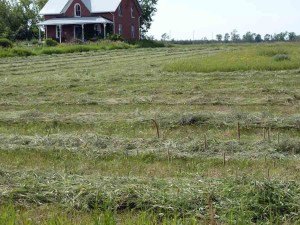
Now that it’s the hottest time of the year it is time to cut hay. For hundreds of years, farmers faced the acres of waving grasses with only a scythe in their hand and knowledge that their animals would starve in the winter if they didn’t get to work. They cut the field in great sweeping swathes. They took a wide hand rake and raked the hay into windrows. They used a pitchfork to stack the hay into small stacks dotted out the field. Finally, when the hay was just dry enough, out came the team and hay wagon with its two tall racks at the end. All of the hay had to be pitched by hand onto the wagon until the hay towered above the racks. One man pitched, another carefully built the load, an art in itself. Badly built loads could slide off onto the ground when the wagon took a corner or hit a grade. Imagine the weary groans.
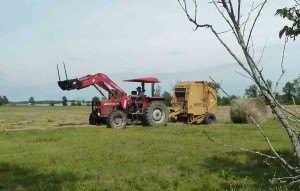
Along comes the baler making giant bales no human hand need touch.
At the barn, the great double doors at each side were opened so that the team and wagon could drive right inside. Now the load had to be pitched up into the loft by hand to be stored for the winter. Lucky farmers had a great claw on a pulley suspended from a track far up under the roof peak. With a team of horses on one end of the rope, the claw could grab large sections of the load and carry them along the track to just the right place in the loft to release them. The farmer’s judgement was critical here. If too much moisture got packed in, mould would result or heat would build until the hay loft burst into flames from spontaneous combustion.
Winter’s dinners ready and waiting. If you’re a cow.
Haying this way was one of the dirtiest, hottest jobs on the farm. At the end of the day the workers were covered with itching chaff and dust, seeds and bits of hay all glued to a sweaty body. No matter how hot, long pants and long sleeves had to be worn to keep the sharp ends of the hay from stabbing holes in exposed skin.
How things have changed. Today, a farmer need never even touch the hay. He simply brings in a modern disc mower which cuts and conditions the hay, leaving in in ready made windrows. When dryness is right, out comes the tractor again hauling the baler which eats up the windrows and drops gigantic bales behind it. If needed, the baler will also wrap them individually in plastic so that they can stay in the field until it’s time to use them as feed. A fork on the front end loader then picks up the bale quite effortlessly and drops it where the hungry cattle can munch it down. The farmer remains in the ergonomically designed seat in the heated/air conditioned tractor cab, freshly showered and comfy, often with entertainment centre and GPS to keep perfectly aligned in the field.
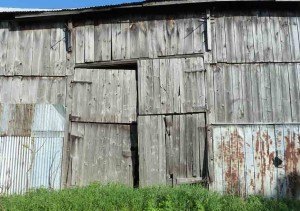
Decaying barn doors where the teams and hay wagons used to go through.
No more sweating. No more pitchforks. No more scythes. One only hopes modern cattle can appreciate the hay just as much.
Kisses of Gold is the new ebook edition of one of the first romance novels I ever wrote many years ago. I have much affection for the book. I’m afraid I was under the influence of Violet Winspear, the queen of desert princes, brooding aristocrats and dark, sardonic rogues, all rolling in cash, of course, and all hiding the lonesome, yearning heart so irresistible to romance readers. Raoul del Rey (dontcha love that name) is my version.
True to form, he drinks his coffee black and bitter, grew up wild in the mountains of Peru and will stop at nothing to grasp his goal. Our heroine fights gamely but the odds are against her in a strange land as she gets hopelessly lost at the Carnival in Lima or tries to fend off Raoul when he has her alone in an ancient Inca stronghold.
The chase is a lot of fun to read and I sure did a lot of research on Peru. Even now I am astonished at the colour, detail and atmosphere of Peru I managed to evoke. I had a lot of energy then. If nothing else Kisses of Goldmakes one entertaining travelogue.
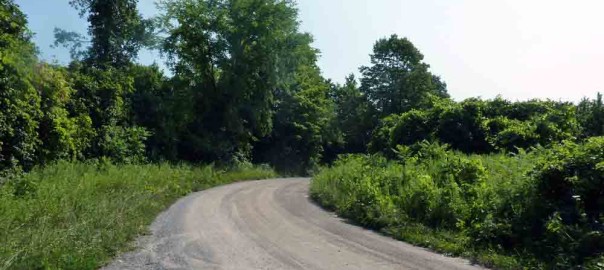
It’s road season in the country No snowbanks, no black ice, no whiteouts, no blizzards. Turtle-dodging month is over. They have laid their eggs and either got back to the marsh or been flattened trying. The gravel roads have been graded and many of the pot holes have actually been filled thanks to the county crew cruising about with shovels and a mound of asphalt in their pickup.
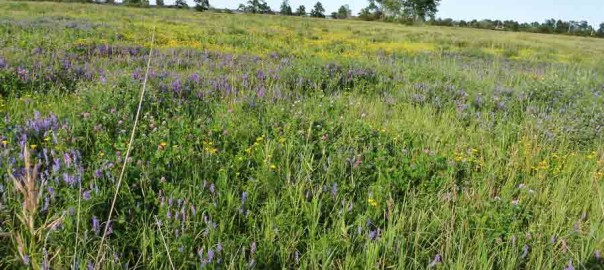
Now is the time to take to the back roads if only to look at the riot of white, yellow and purple wildflowers blooming in the ditches. A deer might flash across in front of you or a flock of wild turkeys drift along just over the
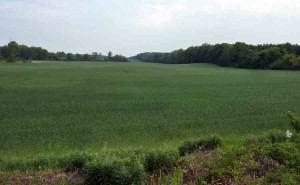
Young grain stretching back to the woods.
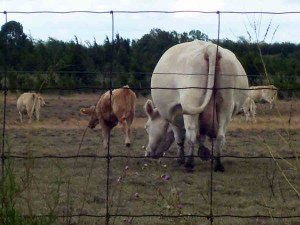
fence. Wildlife is quite habituated to moving traffic, not even looking up when a vehicle whooshes past. Only if you slow to get a look do the critters bolt for the brush. It’s different with cattle and horses. They’ll come right up to the fence to give you a good sniff or a lick. You’re the big event in their day. Sheep don’t care one way or the other.
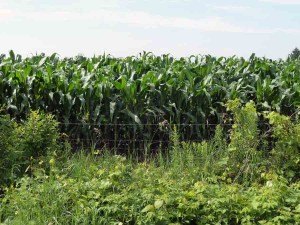
You’ll get a close up look at crops that feed us. Corn, wheat, soybeans, oats, apple orchards. There’s old houses and falling down barns or maybe just stands of lilacs to show where a farmstead used to be. This is where you find the odd big elm that has survived Dutch elm disease shading all across the road.
Fine view over the fence.
Likely as not, there’s a wide spot to pull over and nice grassy bank beside a narrow old bridge and a creek for a picnic because there’s no Tim Horton’s. You’ll dip through swamp and be able to peer straight into straight into dim depths where the tree canopy shuts out the sun and water lies pooled among the roots. That swamp road was once made of logs laid side by side with enough gravel thrown on top to drive a wagon across.
Of course, you’ll also come across, at the end of some back-of-nowhere, washboardy, cedar overgrown road, a glittering, newly built abode complete with pool, sunroom and solar panels.
People are catching on about country roads. Enjoy them while you can.
When the first bottled water appeared on grocery shelves, we all fell about laughing. Who would be idiot enough to pay for water when they can get it for free at home?
Well now the joke’s on us. After years of relentless marketing, supermarkets devote whole aisles to bottled water. Customers line up to pay and wheel out cases of the stuff with sheep-like obedience. The big corporations rub their hands in glee. That have actually convinced the population that water they pay for is somehow better than water freely available at home.
The profits are huge.
In the past 30 years, the consumption of bottled water in America has been boosted from just over a gallon to 30 gallons person even though the cost of that water averages 2000 times the cost of tap water in their home.
How’s that for a triumph of persuasion!
Now that we have been successfully trained to choose bottled water, I can’t help but suspect we are being quietly prepared for a time when our sources of water will be corporate owned and we will all be forced to pay for the one thing none of us can live without. Call me paranoid if you want.
Public drinking fountains are disappearing, forcing thirsty people to buy a drink. At meetings where there used to be glasses and a jug, there is now a row of water bottles. Characters on TV and in movies no longer run a glass of water to drink but reach for bottled water, modeling commercialism for the watchers, making bottled water the norm. Guests are automatically offered bottled water instead of a drink taken from the tap.
Yet water is the one substance that should NEVER be sold. It is given to us freely by nature and belongs to all of us. It is our birthright. It makes up 65% of our body. It is the very stuff of life, not a product. Without water, we could not survive for more than three days. If there is any cost associated with water, it should be service charges for treatment plants, reservoirs, infrastructure to bring water to us. Never for the water itself.
Bird killed by swallowing plastic for food.
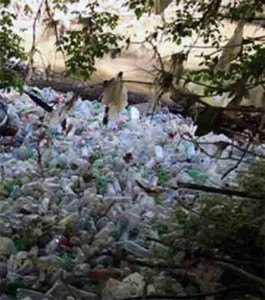
A glance at the facts is hair-raising. Millions of barrels of crude oil go into the manufacture and transport of the 29 million bottles of water Americans buy. If you want to grasp how much oil it takes to make one bottle, imagine a bottle one quarter filled with oil. All these bottle create a horrendous, and totally unnecessary, pollution problem. Only about 13% of them are recycled. The rest disfigure our shores, choke seabirds to death and cram our landfills. They take centuries to to decompose and give off toxic fumes when incinerated.
In Canada, the average family buys 1000 bottles of water per year. That’s at least a $1000 out of their budget they could be spending on hockey gear, music lessons or a joyful family vacation in one of our national parks.
River choked by plastic bottles.
The kicker is that bottled water is often inferior to tap water which is subject to far more rigorous standards. In fact, about 40% is tap water slapped into bottles with fancy labels and sold to the credulous. A good percentage has contaminants beyond health regulations, not to mention the hormone-disrupting chemicals leached out from the plastic container. Millions of gallons are shipped in from other places such as Europe and Fiji, using up precious nonrenewable resources and sucking up someone else’s water supply.
So my reaction when offered bottle water is, “Yuck! No way.” Let’s all do our best to protect nature’s life giving gift by keeping our money in our pockets and vowing that never again will bottled water touch our lips.