Blog

You Gotta Love a Maverick. Every Herd Has One

Sharper, warier, just plain smarter than the rest. Far too smart to be suckered in by the corral and the cattle trailer.  Oh no, sure looks like a bad end could come of that.

This weekend it was time to take the cattle out of the pasture for the winter.  This involves driving the herd into the corral, slamming the gate shut and shunting them onto the waiting cattle trailers, load after load, until the last one is gone.  Persuading the cattle out of the wide open field into the corral is the tricky part. For weeks, hay and treats were strewn inside the corral so that they’d get used  to stepping in for a nosh and ignoring the high, enclosing walls. After all, the gate was always open, wasn’t it.

So the day came with a number of portable metal stock gates hooked together to guide the cattle into the corral.  After a drought-stricken summer, the animals come running when called to get the bale of hay feeding them in lieu of the nonexistent grass. Sure enough, they came out of the cedars and, with a bit of urging, ambled obligingly into the corral and were shut up.

All except the maverick.

Now the maverick is pretty well always a cagey female who has no problem at all peeling off from the herd and taking to the trees when the herd is being herded.  Often, she has a calf by her side and teaches the calf her own independent ways. She is the bane of farmers and can be practically impossible to corner and capture.  The more riled you make her, the faster and dodgier she becomes. Some farmers have become so enraged with this perversity that they finally resorted to a shotgun to end the fugitive’s defiant run.

mavericksuv

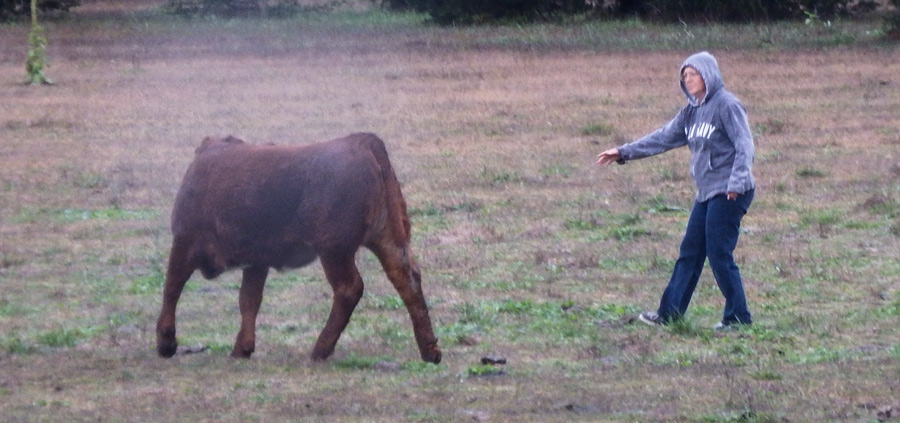
No, we’re not going into that corral no matter how much you chase us.

The maverick this year was a brash red cow with a half grown offspring trotting to her heels.  The rest of the herd milled in the corral.  Two large cattle trailers waiting to start taking on their load. Everyone watched as the cow and her calf dodged this way and that and would not be tempted into the enclosure no matter what bribery was offered. Exhausted herders ran to head her off, then ran again as she outflanked them, then bent over wheezing and panting as the cow and calf headed for the back of the field, the urge for freedom proving far stronger than any instinct to stick with the herd.

The herders took to their SUV which could outrun the cow but not make her stay in front.  Again and again the fast vehicle got ahead of them and headed them off.  Again and again the red cow and her offspring simply turned aside and headed for the cedars and rough ground again where they had the advantage. With impatient cattle trailers waiting, the herders finally abandoned the chase. The rest of the afternoon was spent loading and moving the cattle in the corral.

mavericktruck2

Nope, treats in the back of the truck won’t work. You know where you can stuff them.

Only when they were all gone did the herders return.  Not only were the dark cow and calf hard to see in the brush but they no longer had the pull of the rest of the herd to tempt them near the corral.  Capture now required a different strategy. The cow and her calf had had ample time to cool off, perhaps even time to forget why they had been so riled earlier.  The white pickup, used to deliver hay through the drought, drove slowly into the field and stopped.  The herders called, as they always did when bringing day. “Co’bos, co’bos, co’bos,” echoed out, carrying it’s message of bovine munchies, a call that always brought the herd running.  Sure enough, the red cow and her calf emerged from the woods and trotted up to the back of the truck and tucked into dinner.  Slowly, every so slowly, the truck began to inch toward the corral, the two animals following, their noses buried blissfully in the hay.

maverickcorral

Won’t be one of that soft headed crowd.

It worked a treat–until the truck began to crawl through the cattle gates surrounding the corral.  The red cow’s head flew up. No way was she falling for this old trick. She and her offspring turned their backs and briskly sauntered off in the opposite direction. No more would they come near the truck no matter what was offered them. Last I saw was the pair vanishing into the cedars. The weary herders slammed the tailgate shut in defeat and gave up for the night. My sympathy went out to both sides of the game.

mavericktrailer

Not getting into that thing either.

Of course the red cow and her calf will eventually be captured somehow and shipped to join their fellows. They can’t spend the winter in the bush.  And the trip isn’t to the slaughterhouse, only to a barnyard with food and shelter for the cold season. If she’s lucky, the red cow will be back in the spring with a new calf to learn her ways.  If she’s not, if she’s caused too much annoyance and frustration, she will not be seen again.

Hence my theory about the constant human assault on herd intelligence, be it cattle, sheep, goats, pigs, horses, whatever.  The maverick is the one just a bit brighter, wiser, shrewder than the rest.  So she is the one who causes the most inconvenience to the farmer, disrupting routine, fighting orders, spotting the weak spot in the fence, refusing to obediently submit.  Ergo, which animal is the farmer going get rid of first — that *#@*%$ contrary troublemaker.  Oh yes, she’s going to meet her Waterloo just as quick as he can send her. And by doing so, that animal’s superior intelligence is removed from the herd. It cannot be passed on to  improve the collective brain power. This is selective breeding — downward.

No doubt this has been going on since animals first became domesticated. While I can’t blame a furious, exhausted farmer who has been outwitted once again by a gate-opening sheep or a cow that hides deep in the woods, I can’t help but wonder how astonishing these domestic animals would be now if only we hadn’t spent thousands of years knocking the brainy ones out of the mix.
Another Accident in My Yard. Speed Demons Plague this Rural Corner.

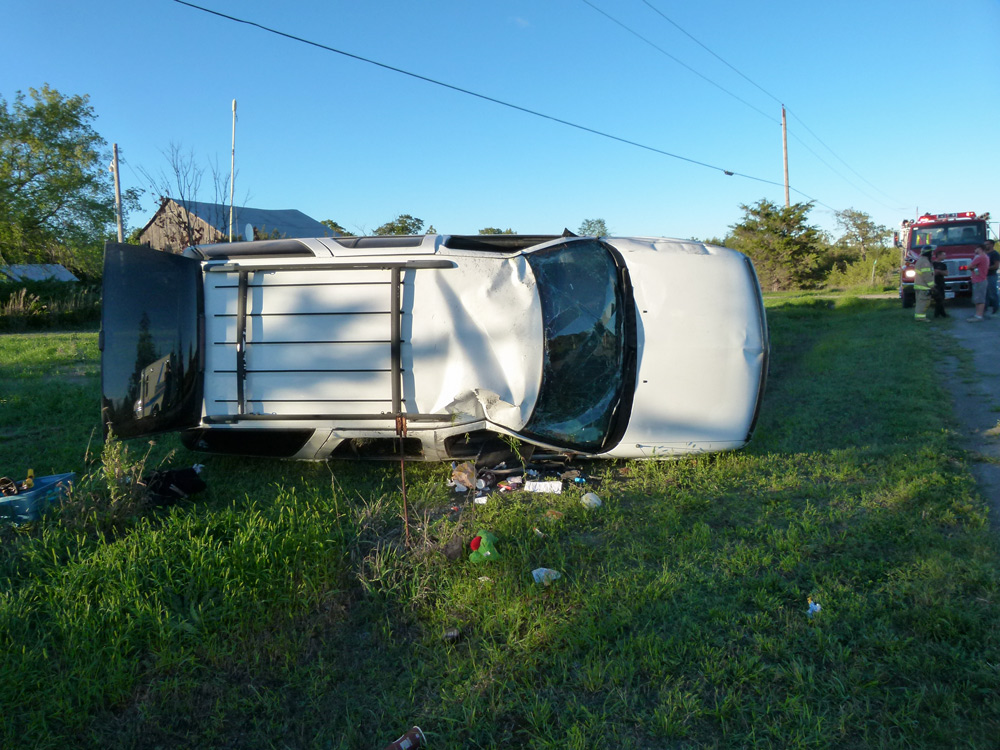
I noticed a black car swerve and barely recover.  Saw the wild spurt of dust.  Heard the awful bang. Ran out to find the white van on its side on my grass, wheels still spinning.

So next was to venture over, dreading what might be inside. Lucky for me, the black car did a U turn, sped back and disgorged a young man who ran bravely up to the van window.  Shortly after, two more cars screeched to halt, one with a woman who was an emergency room nurse. As I gingerly approached, the young man talked away to someone inside the van.  To the immense relief of all, a woman eventually stood up inside the sideways vehicle, her head emerging from the smashed driver’s side window.  Apparently unhurt, she wanted to find her phone to call her day care.  Her next thought, which came with a grin probably induced by shock, was the photo she could now send to her boss proving why she wouldn’t drive to work in the morning.

fencecar

A recent speeder did a full circle to mangle the fence and ruin her car.

The nurse advised her not to try to climb out the window so we all stood there until the village fire trucks roared up along with the ambulance from town and eventually a police car. Children’s toys, coffee cups, papers and assorted other debris spilled from the lower window, also broken.  The fire department, all togged up in firefighting gear, ran a hose over, standard procedure in case of fire or explosion. They popped open the rear of the van, again pulling out a child’s bike and another cascade of  family clutter before the woman was able to crawl out, shaken, but luckily all in one piece. Her seat belt saved her from being thrown out and splatted by centrifugal force.  I cringed at how close she must have come to hitting the black car on the road head on and what a mess that would have been. Right in front of my window.

Her next most urgent desire was to have a smoke.

This driver, like all the others, claimed, with wide-eyed wonder, that “the car just went out of control” before sheepishly confessing how fast she had really been going.  She adds herself to the parade of accidents, skids, near misses and rollovers that happen in this exact spot.  Last month I drove home to discover a car enmeshed in my pasture fence and a woman standing looking at the damage in  stunned confusion. She took out four steel posts, mangled the page wire and turned her car into a write off.  Of course her car, all by itself, perversely “went out of control” landing her in my domain.  The pasture was full of cattle and required three steel gates to fill the gap until I could wrestle with her insurance company into paying for fence repairs. The lady had been on cruise control, above the speed limit.

Others have gone before her. A teenage new driver took out my fence anchor posts, another car flattened my mailbox, yet another ended up deep in the ditch to be pulled out by a friendly passing pickup truck.  All my culverts have their ends smashed in from cars skidding off the road.  My poor ornamental pine got flattened and now leans drunkenly in a determined effort to keep growing.  A stunted oak in front of the barn sports a large healed scar from a vehicle collision.  That fellow irately demanded why  a damn fool tree was growing there anyway, despite all the empty space around it he couldn’t seem to find.  The fence has been knocked down by a little red car that rolled right over it into the field, leaving a trail of broken glass that had to be painstaking picked up before the cattle could swallow any.

This slideshow requires JavaScript.

Nowadays, with the advent of 911 into the country, police, fire and ambulance can be summoned in a moment.  Previously, someone would knock on the door asking if they could call their parents and they were really going to get it because it was their mother’s car they were driving.  Other times, if the car was driveable, parties just backed themselves out onto the road again and sped off leaving bits of chrome, metal, headlight splinters and more fence damage as their only trace.  And this is not counting all the times I hear the crunch of gravel and see the cloud of dust telling me someone veered off  the pavement and had a close call.  Once, a long time ago, a small truck rolled in the yard at night and the passenger (no seat belt) was thrown out was killed.  Luckily, no one has been hurt very much since then but at any moment I fear that story could change.

Not to mention that I walk across that spot every day to get the mail or hike the fields.

My corner is not a bad corner or in any way remarkable.  It is a fairly gentle curve with wide shallow edges and better visibility than dozens of other corners on rural roads. So why can’t folks keep their foot off the accelerator when heading into it?  Probably its the long straight stretch just before, tempting the speedsters.  I get to know them, sort of.  Like the adrenaline junkie on the motorbike I called the Green Hornet who you could literally hear coming a mile away.  There’s a gray Subaru that flashes past early in the morning, making my stomach crunch until it makes it safely out of my neck of the woods.  There are even dump trucks that thunder and shudder as tough guy drivers boost them into racing mode.

Sooner or later, someone else is bound to over correct at the curve or get caught in the gravel and spin round out of control once again. I tell myself that any corner on any road probably has its own history of skids and mishaps.  I just have a front row seat at mine. Half a mile down the road the brush is still broken from where someone went over the escarpment, all the way to the bottom.  A mile up the road, on a far worse curve, a cross on a burnt tree marks the grim end of someone who hit black ice.  One of my earliest childhood memories is of seeing the breadman’s trunk being hauled up from the precipice just beyond that curve. I don’t think the breadman made it.

However, I have noticed a new development along our roads, the appearance of vivid lime green on black signs announcing “High Collision Intersection”. It’s time to call the county engineer and agitate for one of those on my very own speed strip.

If anyone pays attention to signs.


You Can’t Beat the County Fair for Fun

Every year we go to Picton Fair which has been put on since 1831.  It’s ours.  It’s family.  We look forward to the same things every year even to the one day when it is traditionally rained out.  This year it was Saturday night when radio and TV began to blare with unheard of tornado warnings. Tornado’s?  This ain’t Kansas. We’ve never heard of such a thing here before. Other parts of Ontario may get a very rare tornado (Goderich had its downtown pretty well ripped out a few years ago) but not safe old Prince Edward County. There was rain, there was wind, and even a note that a low grade tornado headed for Bloomfield.

This slideshow requires JavaScript.

However, I went in the morning, all sunny and hot.  First the horse show where a young girl who had much trouble getting her fat palomino pony to canter, carried off first prize for both English and Western classes because she was the only competition.  Proud parents hanging over the fence lugged a big camera and fussed happily over English polish and Western glitter. Next was the 4H Calf Club with nine to eleven-years-olds hauling their halter trained young cattle around in a circle for the judges. Half grown steers and heifers are not necessarily cooperative. Some young members needed adult assist boosts to get their animals moving.

The hockey arena was transformed into a showcase of splendid vegetables and flower arrangements.  The massively entered baked goods competition was kept behind glass, perhaps to keep the exhibits intact and safe from hungry admirers.  Pies, muffins, breads, elaborate cakes, all with a wedge cut out for the judges to taste. Best job in the fair, I think, judging the baked goods.

On to the fancywork show where the county quilters display their astonishingly skillful and intricate quilts.  To me, superhuman focus is required to ever finish one of these quilts.  Besides the quilts, there was stitchery of all sorts of knitted hats, mitts, baby clothes, an so on.  The nursing and retirement homes had their own displays of handiwork too.  Old fingers are still skilled. The cat show, which usually also runs in this venue, had to be canceled for lack of entries.  Next year my own kitties might have to step up.

After that the food vehicles making an alluring circle in the parking lot.  Not to be outdone by the Toronto Ex, we, too, have deep fried pickles and Mars bars.  I went for my favorite sausage on a bun with fries and a root beer, powering up for a tour around the antique tractor show and an envious look at the big shiny new ones. Sadly, the demolitions derby was not on until later, so I consoled myself with a visit to the poultry building where ducks, geese, pigeons along with every kind of chicken and fancy rabbit was on display.  Around the outside, for the children, pens with baby pigs, a donkey, a pony, a llama and some sheep were within hand reach.

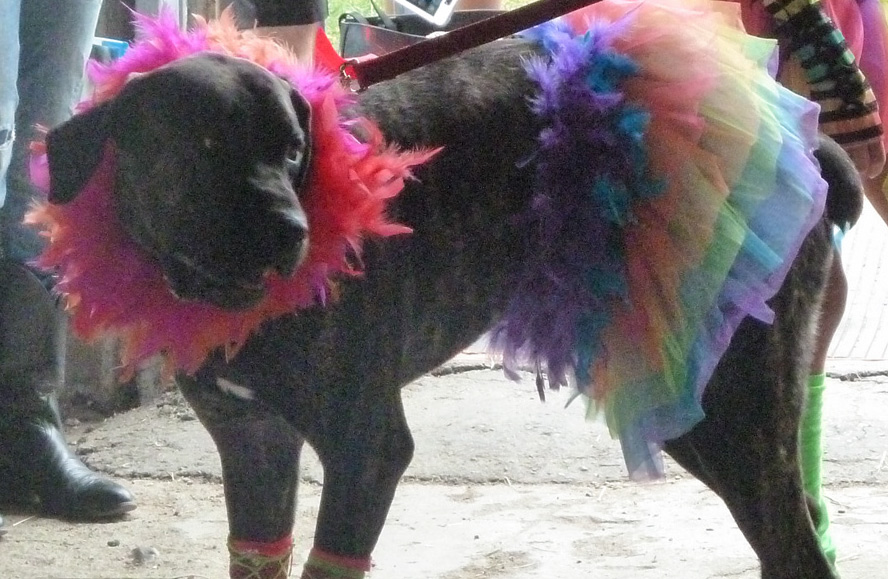
In the wide open doorway the best dressed dog competition was in hot contention as well as best dressed matching dog and owner. A shiny gowned young girl and her dog, which had trouble keeping on its red wig, won that one.  I think they were characters from the movie, Frozen. Which reminded me that I needed an ice cream cone then and there from the fundraising truck, manned by enthusiastic teenagers, just outside.

On to the Crystal Palace, our scaled down version of Paxton’s 1851 Crystal Palace in London.  Ours dates from 1887 and, saved from neglect and destruction, has been lovingly restored.  It’s the only one left of the many built all over North American in the 19th century. A big factor in its current usability is the replacement of the bands of windows with unbreakable clear plastic. The building stood boarded up and dark for so many years because vandals could not resist flinging stones through any exposed glass.

The Palace is full of art work and photography.  I even entered my fav snake photo in the Wildlife class and was told I would have won a ribbon had I remembered to put my exhibitor number on the tag.  Oh well.  Lots of other gorgeous photos to see as well as paintings and drawings.  Exit with a bag of local cheese curd in hand.  Passed through the county tree service display which included a cross section from a log with rings dating back to when the first United Empire Loyalists settled the county in the 1780s.

So, on home to devour the curd with relish and sit out the evening rains.  The county is so desperate for water that I’m sure people at the fair are delighted to be rained out.  And, if outdoor events had to be canceled, there is always the wrestling to keep the crowds entranced. Next day some claimed we got a whole inch of water from the sky.


Now They Say It’s a Hundred Year Drought

Grass2

A few brave blades dare to spring up. Is it time to cut the grass again?


Our waterless summer marches on into September.  Since May there’s been a few scattered showers and, in August, two whole days of light rain.  Not enough to replenish anything. However, nature tries hard with what’s on hand.

Those two days were enough to bring grass back in patches, mostly where it had been protected by some shade. The parts that have been roasted crispy by the sun have only managed to put out a wispy blade or two barely visible amidst the tangled dead mat of former days.  However, another shower is predicted (40%) for this week.

WetLd

Shrunken wetland now just cracked mud.

Perhaps, before everything freezes, I may have to haul the lawn tractor from the shed if only to knock down the never-say-die chicory and blue devil rather than trim the struggling grass. The machine hasn’t been started since May and will be mighty surprised to be pulled from its long summer nap.

WetLdStump

Receding water reveals how the beavers have been gnawing down the ash trees.

The new grass has provided a kind of phantom respite for the cattle in the pasture.  It is still mostly too short to graze but gives a green haze to the ground and no doubt smells maddeningly delicious. The cattle no longer have time to lie down in the pond mud to keep cool.  They are too busy scouring the acres, back and forth,  for anything new that might be edible. In the end, they come back to their ration of hay.

WetLdOak

Large pasture oak giving up on keeping leaves.

Meanwhile, my wetland continues to dry out and my swans march about the farm seeking who knows what.  Perhaps a place to swim where they won’t keep getting stuck the mud. The receding waters have left water plants stranded, reeds drying out and shown up the number of stumps from where the beaver have been gnawing down the ash trees.  The trees themselves try hard to maintain a few handfuls of green leaves while others simply give up and drop all their greenery hoping for better luck next year.

Rain

Rain, rain, come again. And hurry it up. The countryside can’t keep living on dew.


Drought Update: The Swans are Moving Out

Swans4

Mom, dad, four grown youngsters marching across drought-stricken pasture far from home. Breasts are muddied from running aground in shallow water. Even the cedar trees behind are brown from thirst.

My pair of wild mute swans, which returns faithfully every year to the beaver pond to raise a family, finally gave up on me and set out with their brood to find a new abode.  They come before the ice is melted to get an early start on their housekeeping.  Mom can be seen on her nest among the reeds long before the leaves come out.  The pair hatch their babies and watch over them fiercely while the little ones learn to paddle and poke about in the water for food. You can’t sneak up on them.  They know where you are hiding and calmly glide away to the opposite side of the pond, the youngsters with mom in the lead and dad guarding the rear.

SwanNest3

Mama swan getting a very early start on her nest in spring.

Despite their vigilance, they haven’t escaped the perils that lurk in and around the pond.  They hatched seven cygnets, four managed to grow up.  Who knows what picked off the others.  Perhaps a big snapping turtle attacked from below.  Perhaps a coyote got lucky.  Perhaps one of the bald eagles returning to the county swooped off with a tender lunch. Whatever happened, it must have been a fast grab and run for papa or mamma swan in full battle mode can drive off just about anything.

As the pond dries up, the swans have been pushed back into a shrinking body of water.  The large expanses at the front have become arid regions of cracked mud but there is still a decent amount of water covering the old farm pond and extending back into the trees.  Quite enough, I thought to keep the swans happy until migration time.

So imagine my surprise when I spotted the entire family far from the pond and marching solemnly along the page wire fence that separates the field from the road.

At once, a truck screeched to a halt with a couple who insisted that the poor things were looking for escape and the coyotes would get them all if I didn’t open the gate at once and let them onto the road.

Oh sure, you can just imagine their chances out in traffic and there was no way they would make their way down the vertical escarpment to the marsh.  I told the agitated folks to let nature take its course and leave the birds alone.  The couple drove off, much ticked with me.  The swans turned around in a leisurely manner and started heading back toward the pond.  They showed little fear of people and no inclination to rush.  Besides, I’m certain they could all fly perfectly well if they wanted.  It was probably a scouting trip, or an excursion to educate the children about what happens beyond the pond when it doesn’t rain.  From the mud on their breasts they have been running aground a lot in shallow water.

SwanBabes

Swan family back when they still had all seven babies.

I went home and the swans went home but, according to the ever vigilant birders who watch the pond, they didn’t stay there.  Below is an excerpt from the daily local birding report from  our favourite nature source, naturestuff.net:

The Hamilton Wetland, normally a daily hotspot, is deteriorating due to dropping water levels. While there is still water in the back part, out of sight from the road, the front part is little more than blackened waste with the slough gradually loosing its appeal to birds. In fact, yesterday, a family of MUTE SWANS  was marching across the dry pasture field, presumably in search of more hospitable abodes. They may have found it as only 2 MUTE SWANS  were there last night among the paltry nine species present, including 80 CANADA GEESE, 30 MALLARDS, 4 GREAT BLUE HERONS, 2 GREAT EGRETS, 1 RED-TAILED HAWK, 2 LESSER YELLOWLEGS, 5 AMERICAN CROWS, and 2 black capped chickadees.

I wish the swans good swimming and plenty of chow wherever they set up residence.

Epic Drought When Cattle Have Nothing to Eat

DrCattle

Nothing for lunch in the pasture. Bring us some hay!

They say it’s the worst drought around here since the 40s.  Our county never was big for rain.  We get the second lowest in Ontario which makes us great for vacation land but tough for farmers.  This year we’ve had six months with about an inch of rain. Wells are running dry and the water delivery trucks are pounding the pavement day and night.  My lawn mower hasn’t been out since May and the pasture has finally dried up to the point where the cattle have nothing to eat and have to be given hay.  They spend more and more time trying to forage around the shrinking beaver pond.  When I go back, I see they have even chewed on the swale grass, a sharp, hard, mouth cutting grass that is truly a last resort.

Wild geese wondering where the water went.

Wild geese wondering where the water went.

The water around the beaver pond has been evaporating, turning from a wetland that attracts birders to a  black expanse of arid bottom.  Now flocking geese stand around looking bewildered on great swathes of cracked mud where they used to swim. The cattle are so hot they have taken to lying down in the mud that remains damp to keep cool.  Many roadside trees, lacking deep enough roots, have turned brown and are dropping dead leaves.  Grass everywhere has long ago turned sere and crispy, going dormant to survive.  Of course the entire county is under a strict fire ban and we all live in fear of that careless cigarette butt tossed from some car window. Should anyone trying to barbeque inadvertantly start a grass fire, they will get a stiff bill from the fire department after the blaze is put out.

Brown roadside trees can't keep their leaves.

Brown roadside trees can’t keep their leaves.

We are used to drought periods but not like this.  Farmers are suffering the most, with crops drying up in the fields like the shrunken  cornstalks, visible along any road, which have given up the struggle some time ago. All the wild raspberries I meant to pick shriveled into stony little knobs before even ripening.    The drought rating in the area is now notched up to severe and folks are asked to cut water use by 50%.  Those trying to nurse along failing wells have cut back to dribbles  weeks ago.  Make a little tea, wash a few dishes, take a one minute shower, flush the toilet only when desperately necessary. Yeah, we know all about water conservation.

Day after day, in blistering heat, we wait and check the weather forecast.  Sun, sun and more sun. The camping trailers and motor homes zoom past, joyfully pursuing a happy holiday of endless sunshine and butt roasting heat. For us, we see our veggie gardens collapse and survivors in the unwatered flower beds too weak to produce a bloom.

Pond snapping turtle making a run for the marsh.

Pond snapping turtle making a run for the marsh.

But hey, we had some showers this week.  Enough so that grass is actually damp.  And the flooding storms of the US are rumoured to be tracking north. We hope against hope that the rain clouds don’t part, as they so often do, and perversely drop their water to the north and south instead. Meantime, we wave at the holidayers and think of the pleasant streams of cash that are our consolation prize.

Oh, and one more big benefit: the mosquitoes can’t find anywhere to breed.

Ancient Violence Discovered in the Pasture

Trap2

Very old leg hold trap with part of a foot still in it, two white bones tight in its jaws.

Sometimes you really gotta wonder what happened.  I have a large open pasture stretching across the entire front of the farm.  Since I can remember, it has always been a pasture, poor land probably not plowed for a century.  Nothing in the open sweep except cattle and, years ago, some horses.  Certainly not a place to hunt or trap.

I’ve tramped the pasture hordes of times, year after year since childhood.  But this summer, right in the middle, I suddenly came upon something I never noticed before.

An ancient, rusty leg hold trap.  Still too firmly anchored in the ground to pull out. Still strong and scary.

And still containing some creature’s foot chewed off in frantic desperation ages ago.

Traptoes

Side view of foot bones with toes and fur below the jaws. Perhaps a fox took drastic action to escape.

The trap is thing of powerful springs and two side pieces that pop up to ensure there’s no way the jaws can open until the pieces are pushed down again. The white foot bones remain gripped tightly in the trap’s jaws, the toes and toenails and even a bit of clinging mouldy fur projecting underneath.  The trap does not have teeth but is lined with hard rubber, clearly meant to hold its prey alive. The prey decided not to wait and sacrificed its toes instead.

I have no idea how old the trap is or why anyone would set it right in the middle of an open cow pasture. It’s not for muskrats for they live in the marsh.  It’s not for groundhogs for no groundhog could dig in the limestone bedrock.  Not for otter, mink, weasel or beaver.  It certainly predates my time and perhaps caught an unwary fox who chose the wrong square inch of the wide grassy field.   The trap is harmless now, its jaws  rusted shut. I certainly can’t open them. No point in moving it now.  The distant trapper and the determined prey turn into one more of the many mysteries that tease on land in odd uses for almost 200 years.

Drunks at the Hummingbird Feeder

chipmunkDr

The one-toed method of guzzling.

I know, I know, I need to hang it out of reach.  If I do, I won’t be able to see it.  So, I refill it a lot and resign myself to supporting a parade of sugar crazed addicts lining up to guzzle the elixir. Humans aren’t the only ones hooked on sugar water.  Ants detect it instantly and send a continuous single line of workers marching militarily from the ground, up the deck, down the wire, into the feeder to load up then all the way back again to their distant ant dwelling.  Wasps crawl in and out  with almost the same regularity while assorted other bugs joyfully lick up what’s stuck on the surface. It is amazing how much insects alone can lower the feeder level.

SquirrelFd

Bellying up to the bar.

Hummingbirds, the legitimate customers, dart in to sip up nectar while hovering lightly on their blur of wings.  They share with a family or orioles who, from the way they stick together, must have hatched in the same nest.  The bright orange orioles flutter and squabble over turns at the bar. If the feeder is gone for refilling, they squawk in puzzled outrage until the source is restored.

Chipmunks quickly developed a craving for the sweet stuff, abandoning the peanut feeder and the quest for fallen birdseed in favour of slurping down the liquid bliss nearby. They do acrobatics to satisfy their sugar demons. Like all drunks, their inebriation makes them forget the urgent business of gathering food for the winter or rushing back to their young.

The chipmunks have to suck up their fill in a hurry before the cute but aggressive red squirrel drives them off so she can take their place. She laps up sweetness only until the big black squirrel arrives and grabs onto

HF-Raccoon

Night raider finishing off the hard stuff.

the feeder like it’s a personal treat dispenser.  Should I forget to bring in the feeder before dark, the raccoons make it their first stop on their nightly round.  Once a raccoon has had a taste, it never forgets. And never fails to raid anything left over in the night.

So the orgy will continue as long as summer lasts. I’ll support the drunks and they’ll supply the laughs. The supermarket cashier will suspect me of addiction too from all the sugar I buy.


Saved from the Rural Road Death Gauntlet

turtle

Pint sized painted turtle saved from a squishing on busy country road.

Pretty cute little critter.  Spotted her just starting across the road, so optimistic that she could make alive.

TurtleHand

Hiding inside her shell. Not even a handful.

I was not optimistic.  She was not even as big as a fist and would certainly fall victim to the first speeding pickup.

Doing my duty, I screeched to a halt, backed up and picked up the tiny turtle to carry her across.  I followed the rule that you must always send a turtle in the same direction it was heading or else it will just turn around and attempt the road again.

Turtle carnage on the roads is usually made up of females. They are the ones who leave safety to lay their eggs far afield, though I doubt this youngster was in the egg game yet. It takes between six and sixteen years to reach sexual maturity so there’s quite a wait ahead.

TurtleRd

Heading for the wilds as fast as she can go.

Junior here is called a painted turtle for her fine decorations of red and yellow stripes.  I hope she is grateful for the boost across the road. She took off through the grass at top speed, lurching over obstacles on her little legs. Good luck and may she not be eaten so she can hit the good times at sixteen.

Birdie Tenants Won’t Pay Rent

Ph-nest2

Eastern phoebe babies waiting for mama to appear with the next fat bug for lunch.

I never thought much about the little gray bird that so often flashed out of my open cellar way when I strolled by.  Since I’m not putting in wood for the winter right now, I don’t go down there much. Eventually, though, I have to put out my recycling before the piles of newspaper and plastic become animated on their own.

Deciding to surprise the recycling truck crew with evidence that I am still alive, I hauled my blue box out of the basement along with the accompanying many bags of extras. Above the outside door light, I spotted a charming bird’s nest of mud and moss, perfectly round and looking constructed by Disney. I climbed up to look and found this picturesque structure empty and long abandoned.  Oh well…

Then, from the other side of the cellar way, I caught the tiniest of movements. Tucked in between a two by four and the hot tin roof, was another nest, untidily squat and crammed to the brim with shadowy inhabitants. Okay, shift over to have a look.  Hiding out in this narrow space was a menage of baby birds, part way between fuzz and feathers, ignoring my gawking and fast asleep.

Phoebe copy

Outraged mama ordering me off.

Mama was not asleep.  She shot into the tree just outside, hanging off the tip of a branch and screeching her outrage at me.  I got down.  Mama was not mollified.  She screeched even more, flitting away and flitting back, flitting at the door and doing a last second U turn. Her mate also flew about but without mama’s fury.  He perched on the clothesline and chirped half heartedly. I suspected there would be some hot domestic words between them after I left.

The birds are eastern phoebes, little gray songbirds with pale bosoms.  The are so named from their raspy “phee-bee” call heard so often from the trees, one of the earliest signs that spring has returned. They wag their tails and pick their diet of insects out of mid air. My phoebe set up house with me without asking and, no doubt, hoped to escape my attention entirely until she could leave me a second empty nest. Well, I’ve spotted her. And from the size of her babies she’s got an awful lot of bugs to catch before they are ready to leave.  I counted four at least and they all look bigger than her. So I’ll give her a break on the rent.  It’s a drought year and she has a big family to feed.