Amiable sandhill crane pair poking about for treats with their powerful beaks.
The regal pair have taken to hanging out some evenings on a patch of crispy dry, grazed-to-the-ground grass just over the pasture fence. They are a sandhill crane couple who have abandoned my beaver pond where the egrets and herons sensibly remain to wade. Instead, the sandhills poke and jab into the baked earth with their powerful beaks, in search of what? Worms, grubs, roots or whatever they are extracting from the dusty bit of dirt among the gravel.
In between, they preen their feathers, stare around them with their eerie red eyes and stroll along with leisurely aplomb. Passing cars and cyclists do not bother them nor a photographer leaning over the fence.
Getting the once over from a skeptical red eye.
They were here last summer too. They had a young one with them then which I hope has now taken up a life of its own. Perhaps this year’s baby did not have so happy an outcome. Foxes, raccoons, coyotes, bobcats, lynxes and eagles are always on the lookout for a juicy juvenile meal. Adult sandhills are four feet tall and have a seven foot wingspan. Not a simple project for a faint-of-heart predator.
Sandhills flit about in adolescent flocks until they decide to pair off any time up to seven years old. Slow courtships for a bird but worth it for the dancing and happy songs in unison bestowed upon a mate.
They eat just about anything from tubers to berries to rodents, lizards, frogs and snakes. They have a bill that can pierce a skull and besides wetlands, they inhabit prairies, open grassland, farm fields (they love farm crops) and tundra. Indeed their favourite regions to breed in are the northern prairies and the high arctic tundra. They take their name from the Nebraskan Sandhills of the American west. Wisely, they take note of the first toe-freezing winds and spend their winters in Florida. And, oddly, that red patch on their forehead is bare skin. Wonder if it acts as sunscreen.
So I’ll keep my eye open this evening to see whether they reappear. They can be difficult spot against brown grass. I suspect the ground by the corral is a favoured spot because it has been so well fertilized by all the cattle who congregate there for a lick of salt. Yum!
Viper’s bugloss. Shot defiantly fast to full height after the mower passed. Thriving even when the grass is dried and crisp.
We don’t have any vipers. We certainly haven’t lost any bugs. So I wonder who named the plant. We just call it blue weed or, more accurately, blue devil. It is blue. It bedevils gardens, yards, farm fields and roadsides for those attempting to keep it out. If you try to grab it, you’ll soon yelp from the stout spines that defend it from you and animals that might want to eat it.. Some people get a rash just touching it. Or get the spines irritatingly under their skin for foolishly forgetting their gloves.
Toughness is it’s trademark, the first requirement for plants that want to make it in our currently drought stricken, gravelly dirt. When the lawn has shriveled into a brown fire hazard, up comes viper’s bugloss, with rough, hairy leaves and aggressive stems that seem to rise defiantly higher and greener each time you look around. They require the yard to be cut just to knock them back even when everything else under the blades, except the equally determined chicory, is simply a spew of dust. Viper’s bugloss loves dry limestone sweeps, waste places, roadsides, railway tracks, cliffs and baking dunes. Unlike it’s neighbour, the dandelion which slyly blooms below blade level when mowed, viper’s bugloss starts all over again with new stems reaching skyward no matter how often it is cut down, a game that lasts until the first frost heavy enough to put it sleep for the winter.
Beautiful blue flowers — defended by spines. Don’t touch!
Viper’s Bugloss is not even a native. According to my plant book, some misguided adventurer brought it to North America as early as the 1690s thinking it would make a fine garden flower. It took to it’s new home with joyful enthusiasm and, not so much later, had farmers cursing as they tried to root it out of their crops. The early settlers, who ate anything they could get their hands on, declared the plant edible, which is stretching it. In early days it was thought to be effective against snake bite, hence the “viper” part of the name. The only catch was that you had administer the remedy before the snake bit you. The other part of the name, “bugloss” is from the Greeks who thought the leaves looked like the tongues of oxen. All in the eye of the beholder, I say.
On the plus side, the showy blue flowers with their red stamens do look striking when they manage to evade you in a flowerbed. They are beloved by bees, providing as they do, a reliable source of nectar in the blooming cycle which lasts from May to September. A cordial made from its leaves was said to relieve headaches, fevers and nervous complaints. The seeds, decocted in wine, were once used to “comfort the heart and drive away melancholy”. Myself, I would tend to suspect this had more to do with the amount of wine imbibed rather than the seeds.
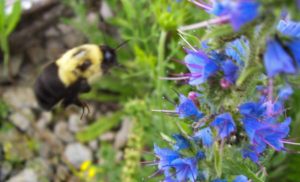
Bumble bee happily headed for a drunken nectar orgy on the packed blue blossoms.
Despite centuries of weeding viper’s bugloss remains a hardy ruffian. Admire it for something that will always grow and always fight back. Don’t think it’s going anywhere soon.
Passing visitor. We always called them black snakes but I think it’s a northern watersnake. They come out of hibernation in the spring, lay about sluggishly, then head for the water for a happy summer of scoffing down yummy fish and frogs. They’re very hard to see among gravel and leaves and they opt for imitating dead sticks rather than skittering off like garter snakes. They’re harmless, of course, but can give you a turn when they swim up to you in the lake to see if you are edible or at least a floating log where they can bask. They happily swim miles from shore and dive ten feet down if there’s any prospect of a meal. I’m so pleased this one paused to smile for the camera.
Wild apple blossoms. These hardy, determined, twisted trees survive amidst tangled brush and crowd into fence rows. Their fruit is small, wormy, of variety gone rogue and often wildly delicious.Find the heron. Great blue herons that fish in my pond prove the worth of their natural camouflage.My swan family. Every year they return to the beaver pond to nest. This year they have seven cygnets and haven’t lost one. Experienced parents at work.
Backside of a toad I almost pureed with the lawn tractor. A very fat and squashy one with lovely lumpy patterning on her back. She finally had to good sense to hop away.
Gardening is upon us. Even us lax folks must make the effort. An effort involving heartless cruelty to all the uninvited little plants thrusting themselves up so joyfully from the earth.
After a long, long winter of cold and snow and blizzards howling about the chimney, after the snows receded to leave us in the midst of a sere brown landscape of bare trees and dead leaves, how we hungered for the first hint of green. This sepia period of spring seems to last and last, freezing at night, leaving black pools of water in the ditches during the day.
At first, only the most discerning of eyes spot the swelling of tree buds in the increasing sun. Then, after warm enough days, the tough county grass comes through, poking up little new blades even through frost on top. One day, a glance outside turns into a double take. The beige yard, the dun pasture are suddenly altered by a wash of green. Green that grows stronger almost before your eyes and spreads around the feet of the glum cedar trees and all the way to the waters of the beaver pond.
That grassy resurgence is the true signal for spring to begin. The tree buds expand and burst, first into spare tree blooms. then into a thickening mass of new leaves. At this time in the season, there is enough water in our droughty region to keep the earth moist and give the year’s best chance for all the sleeping seeds and dormant roots to leap into action. Some newly released life force runs riot through the soil, leaving no bare patch empty. All the plants respond, putting their everything into pushing up soft new leaves that open wide to greet the beaming sun and dewy air.
Nettles do it in the midst of my flower bed. Nettles, dandelions, crab grass, creeping Charlie, even rogue offspring of my Manitoba maple. They have all the freshly minted innocence of wonder-eyed babies or curly faced newborn calves just learning that their awkward legs can jump and cavort. All are miniature and perfect, complex, brimming with youthful vigor. All are utterly unaware of their situation — straight in the path of my trowel.
Yes, how I hate to snuff out their infant lives before they’ve even got nicely started. But I’m not a hunter gatherer. I am from farming folk. Farming folk nurture plants that feed and pay or at least decorate the homestead, not merry interlopers who care not whit about serving human purposes.
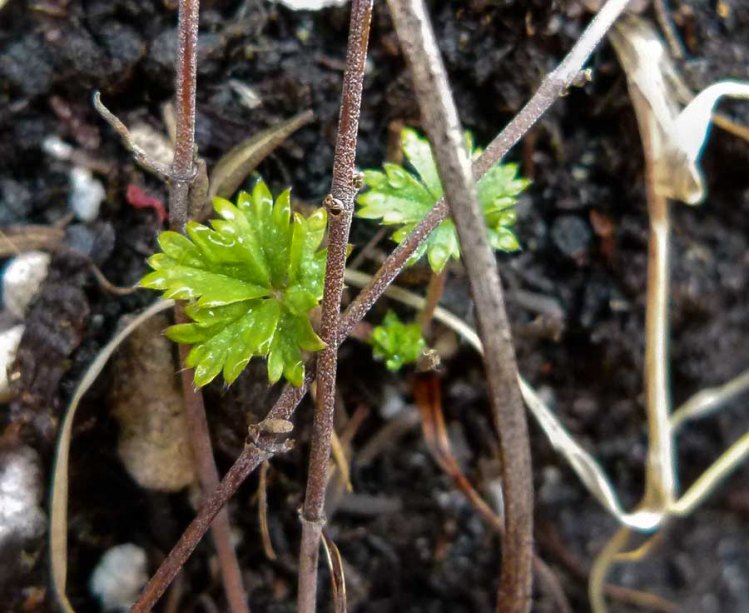
Sorry darling adorable little nettle with plans for spikes that sting me. Slash! Whack! You’re a goner!
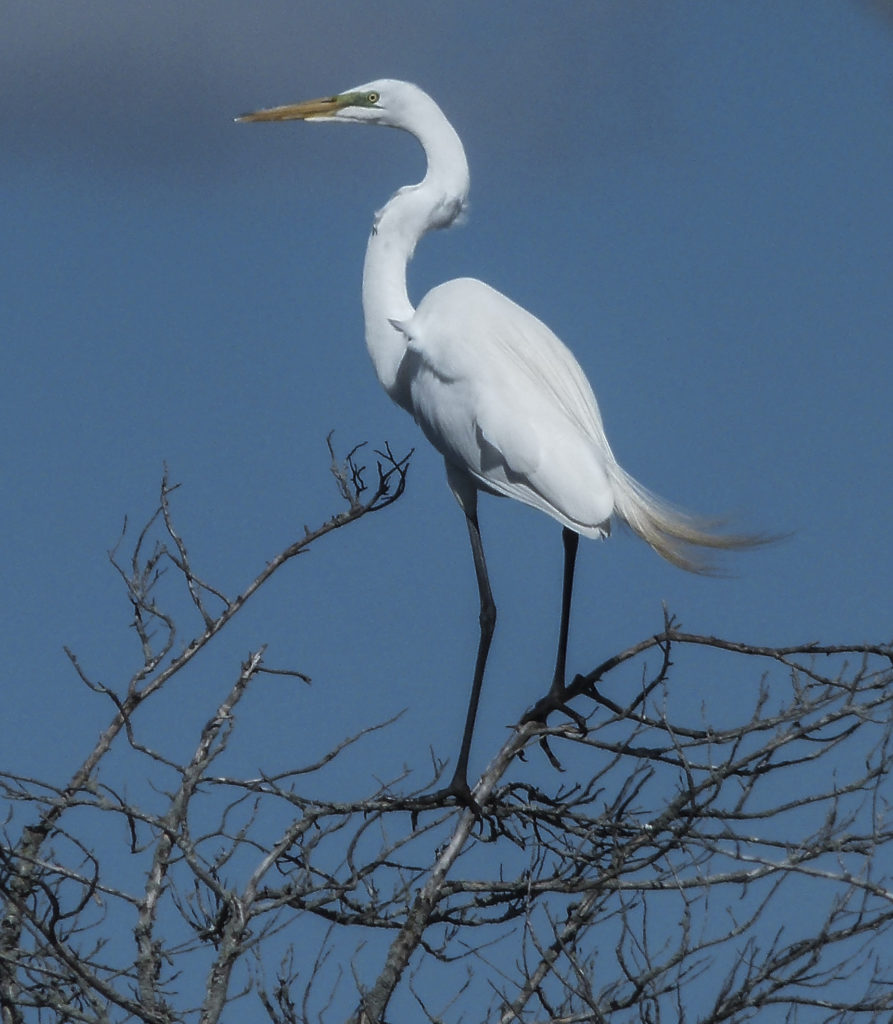
This is a great white egret that is visiting my pond. Caught her preening herself which displeased her enough to fly up into one of the drowned cedar trees and glare at me fiercely. A very beautiful bird but I always wonder about why Mother Nature made egrets and swans white instead of the usual blend-in colours of most birds and animals. Are they not just big white Eat Me signs for all the local predators? And, yes, I have found after dinner piles of white feathers on the ground.
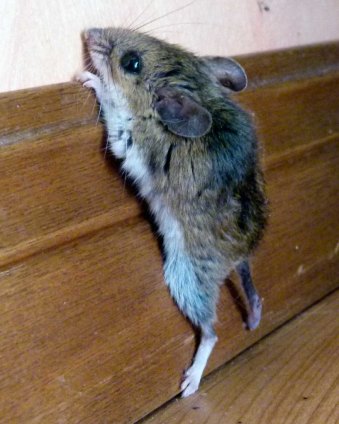
Phew, the cats have finally given up and left me hiding behind the door. Now if I just hang from the baseboard and pretend I am invisible, perhaps this monster with a camera will go away too. Boy, do I have a tale to tell the family when I get home.
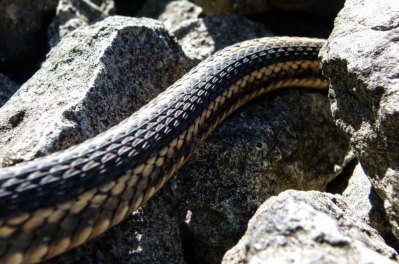
Is it a rope, a cable, a fancy lamp cord? No, it’s the long sinewy body of a garter snake coming out of winter hibernation. All fluidity, grace and speed and beautifully scaled to boot. There’s a special fence post where they all emerge, warm up in the sun, have a sex orgy and then slither off to take their chances crossing the road.
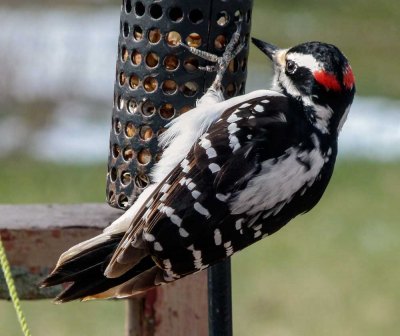
Rat-tat-tat-tat. Hairy woodpecker going at the iron peanut feeder. It’s beyond me how they don’t wreck their beaks on the little holes in the metal but they work hard, often in shifts. Chipmunks and red squirrels can also get their little buck teeth into the holes to empty the peanuts all on their own. Perhaps they need a tad of dentistry afterward.
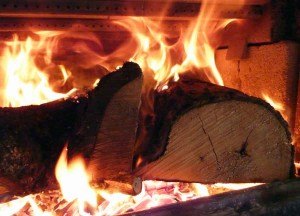
The Fire Goddess thought she had retired for the summer. Ha!
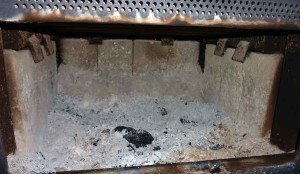
The fire goddess, who lives in my wood stove, has laboured hard all winter to keep me warm. Now that it’s spring, it is time to put her sleep for a well earned summer rest.
Except, spring is not co-operating and I have to keep prodding her awake again. I am only hoping she is not going to get cranky.
A while ago, the new season seemed to blast in with heated breezes and bright sun blazing. It was actually too hot to work outside. Green grass seemed to grow an inch a day. The house suffered another ladybug plague as all the hidden critters suddenly whacked themselves against the warm window glass in their frantic efforts to escape to the bright paradise outside. The first ants appeared on the kitchen counter. Windows and door could be opened to admit, gasp, genuine fresh air. Oh great, I thought. No more tending to the wood stove every few hours. No more carrying and stacking wood ready for the maw of the stove.
So I thanked the fire goddess for all her hard work during those bitter February nights and official put her to bed. I could almost hear her sigh with pleasure at the prospect of her long summer rest.
Except the temperature dropped to -8C, the sun went AWOL, the daffodils got their little tops frozen and it SNOWED!
Back at work until spring really arrives.
Ah, excuse me fire goddess. Poke, poke. Here’s some newly split kindling, here’s some yummy wood dragged from the last cord I just tarped up for the summer. Wakey, wakey. I need to stop shivering.
She obliged, a bit grumpily. Soon the stove was roaring again in winter mode, the fans back in operation to suck up the hot air, the cats back in their January spot in front of the stove.
The sun returned, she got to snooze again, I swept up the wood chips. The sun went in, temperature dropped, rain and wind filled the house with chill dampness. I looked for my fleecy shirts and had to disturb the divine lady once again. She’s back at work again, roaring away this very morning. However, the weather forecast is predicting 15C for the weekend. I have promised her, yes I have, that she can go to sleep for good this time. I’ll soon run out of wood to feed her. And maybe, just maybe, spring will actually arrive.
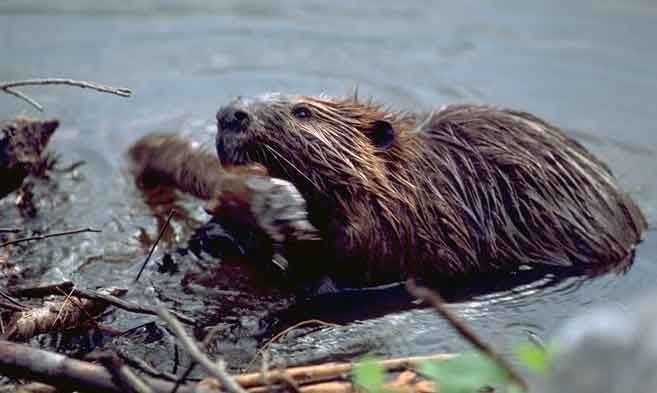
Since International Beaver Day is this month, I’ll tip a nod to the beavers who had made themselves at home on my land.
As I child I only knew the beaver as a mythical creature of the fur trade with a modeling job as our national symbol. Of course I read Grey Owl’s absorbing books about the two beaver kits who turned him from trapper to conservationist after he killed their mother. I knew that beavers had been hunted close to extinction, first in Europe and then in North America, mostly for the beaver hat which no gentleman of the 18th or 19th century could be seen without. The Russians, scoring the processing contracts, fiercely guarded the secret of combing away the guard hairs to get at the desirable woolly fur underneath.
Part of the beaver dam through the woods.Drainage pipe pulled onto land by beavers and bitten full of holes.
With the changing fur trade, or perhaps the demise of the beaver hat craze, beavers began to rebound, not that I had any idea. So imagine my surprise to find my own farm pond on day adorned with a great heap of mud and sticks and a strange dark creature swimming up and down, coming ever closer, trying to check me out. I stared back and suddenly stood up when it got alarmingly close. With a sharp slap on the water, the visitor dove out of sight.
Slowly it dawned. Oh my goodness! That was a BEAVER!
Knowing little about beavers, I thought no more about my new residents until the pond itself disappeared under rising water that slowly engulfed the area and began reaching back into the woods. This was not uncommon is spring or fall, but in a summer drought? When cattle were lucky to have water to their ankles in the bottom of the waterhole?
I slogged back to investigate and, hidden by the trees, I happened upon a massive beaver dam stretching the length of two fields at least. An astonishing construction of mud and sticks stretching at least the length of two fields. The sheer labour involved was exhausting to contemplate. How hard the furry engineers must have worked to construct with two paws would would have taken a backhoe considerable time to accomplish. The legends about beaver industriousness certainly proved true. Good thing some of them weigh up to 60 pounds. Behind the dam what amounted to a small private lake was lapping, an extension of the broad sheet of water creeping into the pasture.
Channel for floating wood.Birch being cut into cordwood lengths, presumably for lunch.
Splashing into the woods, I found the beavers taking them for their own. Beside freshly gnawed stumps, the beavers had actually dug canals to float their felled trees home. This after cutting them into four foot lengths exactly the way loggers do. Did they also have hard hats and posted work schedules? My lovely band of poplar trees was gone, clearly a beaver favorite. Some huge old oaks were dying from wet. Yet the beavers refused to even nibble the plague of eastern cedars moving in on the land. I didn’t yet realize how many cedars would conveniently drown when their roots got submerged.
Not knowing where the water would stop, I had a brief go at beaver warfare, a hopeless enterprise. First, I just dug holes in their dam but the beavers, who can sense running water from fields away, had the holes fixed probably before I got back home. My next bright idea was to bury a length of drainage pipe under the dam with an end far out under the water so they wouldn’t notice. Ha! Next time I came back, the beavers had the end of the pipe hauled up onto land and bitten full of holes. A big thumb of the rodent nose to me. I waited until winter when the beavers were frozen into their lodge and could not swim beyond the larder of twigs with which they had stuffed the erstwhile farm pond. The hole chopped in the dam drained and drained until the vast ice sheet all through the trees cracked and sank. I went home smug.
Until spring. The moment the ice thawed, the beavers plugged the holes and, in a jiffy, had the water up to former levels. Beavers one, me zero.
Former pasture, now under water.
So what do I do next? Well, nothing. I was advised that once beavers arrive in a spot they like, removing them is futile. Other beavers simply move into the place already set up and comfy. As their flood spread, the sheet of water visible from the road began attracting attention from passersby. Birders. The beavers had done what beavers do–they created a wetland. In an era where wetlands get scarcer and scarcer, this new one suddenly started drawing all kinds of wetland species looking for a home.
Frogs, snakes, turtles moved in. Geese and ducks by the flock. Herons and cormorants began to fish. A pair of swans nested and produced a brood of cygnets that glided about for weeks until they could fly. Sandhill cranes started hanging around. One day, I was stopped in my tracks by tall white birds reflected in the water. My first great white egrets, newcomers to the county, took to standing about in the day and
New residents moving in. (E. Miller photo)
roosting in the trees at night, eerily pale in the dusk. One evening, I saw a flock of over fifty flying, flashing white and gold in the setting sun, a sight not to be forgotten. I even had a big white pelican drop in for a day, looking quite lost and confused as it swam about with the ducks. Now birders hang over the fence in chilly dawns, peering through their spotting scopes, for they are not allowed in to disturb either the birds or the cattle. I also refuse all the good ole boys who pull in with their pickups and beg to hunt, tormented as they are by the sight all the fat waterfowl sitting in plain sight, preparing to migrate.
Real egret in my pond. Wow! Thanks beavers. (E.Miller Photo)
So that, I learned, is why beavers are called a keystone species. Monarchs of biodiversity, they create environments which allow dozens of other species, many threatened or endangered, to live and survive. Before Europeans arrived here, there were said to be up to 400 million beavers living from the Arctic tundra to the Mexican deserts. Tough, hardy little beggars, I’d say. Thousands of years of beaver dams catching silt gives us some of our best soils today. Beaver ponds decrease flooding, recharge our drinking water aquifers and remove pollutants from our surface and ground water. Now beavers are being reintroduced to drought lands all over the continent to bring back the water and the wildlife.
So beavers, you weren’t invited but I guess a thank you is in order. You’ve brought a whole troop of new friends with you. The cattle will never be short of a drink again. And there’s still half a field to go before the flood reaches my house.
Today we have a treat, a guest blog post by Rosemary Aubert. Rosemary is the author of the internationally-acclaimed Ellis Portal mystery series and a well-known poet, short-story writer and essayist. She was born in Niagara Falls, New York and has lived in Toronto, Canada for many years. I have long admired Rosemary’s immense versatility as a writer, teacher, editor and friend. Pick up any one of her books and you are in for a delight.
Surprises in the Mail
Blog post by Rosemary Aubert
It’s part of a writer’s life to have a special relationship to the mail. In the old days, before the internet, the mail involved a physical object of some sort—something you could touch, could carry with you, could tear up and throw away in anger and frustration if you felt like it.
Now, of course, the mail—or at least a great deal of it—is different. You can save it, you can print it, you can wipe it away with the single stroke of a furious finger.
But I think that the same shaky feeling, the same mixture of hope and despair that used to overtake many a writer at a glimpse of the mailman (they were men in the old days) coming up the walk with something in his hand—that same shaky feeling overtakes the writer who is awaiting something when he or she presses the button that opens the internet like the knob opened the door of long ago.
Like all my fellow writers, I have had many adventures and misadventures waiting for, receiving, and reacting to mail of one sort or another. Just the other day, I went downstairs to the mailroom of my apartment building to find an ominous white slip of paper pasted to the door. A quick trip to a “pickup centre” soon revealed the dreaded return package which, when opened, showed a slightly tattered manuscript (at least they had read it) and a more than usually polite rejection letter saying my writing was wonderful but not for them.
Even though every writer toughens herself against rejection, I was devastated. But when I got upstairs and opened my email, I found an enthusiastic response from a different editor. So, you see, it works both ways.
I remember the first time I waited for news in the mail. I must have been about ten. I was living in Niagara Falls, New York, and I already harboured the dream of making it big in New York City. As a first step toward fame in America, I had submitted a verse to Hallmark Cards, suffering the abuse of my younger siblings who were, nonetheless, old enough to find my ambition ridiculous. Imagine their delight when an answer finally came in the mail. It was a card from Hallmark. It said, “Better Luck Next Time…”
Many years later when I had become a novelist published around the world, I received an envelope from my publisher—yes, my New York publisher. Thinking it held a royalty cheque for a few hundred dollars, I stashed it in my purse intending to open it the next time I got to the bank. Imagine my surprise when I opened the envelope in front of the teller and found a cheque for twenty-five thousand dollars!
Today, like every day, I will eagerly await the postperson. Will she bring money? An acceptance? A positive review? Or something negative? Or nothing?
Winter bound beaver lodge with food supply just beyond and tracks of coyotes hoping for a meal.
The temperature is heading for a thaw. So last chance to check my beaver lodge. Once the ice melts, there will be no going near it without a canoe. After skidding and sliding over a great expanse of ice, I found the beaver lodge frozen solid and banked with snow, the beavers snugly inside.
There were the usual coyote tracks around for the scent of the fat beaver family just inside must fill them with maddening frustration. They know by now that trying to dig out the goodies is a useless waste of claws. The cold has turned the lodge of mud and branches into an iron fortress impenetrable for the hungriest predator.
The ice of the beaver pond stretches away, smooth and slick with patches of snow here and there for footholds but the beavers made sure they don’t have to go far for dinner. Next to their lodge, filling the depth where the invisible farm pond was dug, is a bristling heap of twigs and branches carefully stored for winter dining.
Mass of branches stored for winter munching. In front is the channel to the larder and wood already dined upon
Up close, you can see the channel the beavers keep open to their larder. Lining the channel is a backwash of discarded branches, each neatly cut to about a foot in length, each utterly stripped of bark down to the yellow wood.
A diet of tree bark is not my idea of cold weather comfort food but the beavers want nothing else. I so admire their digestive tracts, specially designed for bark and cambium, the soft tissue right underneath. Willow, maple, poplar, birch, they’ll devour it all with relish.
Precision cut branch with every scrap of bark gnawed off. Scrumptious!
In a day or two, the ice will start breaking up and the pair of swans who are already hanging about, will set up their nest for this year’s family. The pond will fill again with returning ducks and geese and the beavers will emerge to slap more mud on the dam that stretches across a couple of my fields.
So what’s for dinner in spring, summer and fall. Bark, bark and more deeelicious tree bark. Perhaps garnished with the odd root or bud snatched for a treat while they swim to work each day.
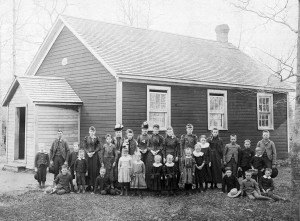
So I was poking about in a old book about life in the 19th century and came across this exam from a little rural school in Ontario. Likely a one room school with a wood stove at the back, snowdrifts filling the roads, wet mittens hung to dry and an assortment of farm kids whose prospects did not go beyond the pasture gate. If you try it, no calculators please, no computers, no iPads, no phones, no asking friends. You are about eleven and all alone at a wooden desk with pencil, paper and brain only. Best of luck! I do not have the answers.
The dividend is 8973219874584, the quotient 7947 and the remainder is 13. Find the divisor.
By what must 17 miles, 121 yards, 31 feet be divided to give 37 perches?
Simplify3/5ths (1-11/2 21/2)of5/7th (1-131/2)
Find the value of 3 3/4 x 1/2 of 2 1/2 x 8-5/16ths x 7/12th-3/4 of 5/12ths
If I buy 80 turkeys at the rate of 5 for $4.00 and sell them at the rate of 8 for $9.00, how much do I gain?
Find the cost of carpeting a room 30 feet long and 8 yards wide, with the carpet 30 inches wide, at $30 per yard.
How many rails will it take to enclose a field 14599 feet long by 10361 feet wide, provided the fence is straight and 9 feet high, the rails to be the longest that can be used.
How many minutes between 12 o’clock noon May 24th and half past 9 A.M. September 3rd?
Find the total cost of the following: A pile of wood 32 feet long, 6 feet high and 4 feet wide at $1.80 per cord. 394560 lb of wheat at $1.30 per bushel: 873200 feet of lumber at $7.50 per M; 498365 pounds of hay at $12.50 per ton. The length of fence rails was governed by law, a legal rail fence was to be built of 12 foot rails, with a three foot crook.
Geography, Grade VI.
Give the names of the Zones and the lines dividing them.
Define: Arctic Circle, equator, tropic of cancer, meridian longitude, strait.
Arrange in order the following places beginning with the one at which the sun is first visible in the morning: Alaska, Peru, Ontario, Russia, Spain, England, Ireland, France, New Brunswick,
What general direction would a ship take in going from California to Madagascar?
In what waters are the following Islands: Manitoulin, Joseph, Walpole, Grand Island, Orleans and Amherst?
What and where are:Vancouver, Belle Isle, Lima, Assiniboine, Chaleur, Corea, Palks, Malacca, Cambodia, Lopatka, Formosa, Madias, Damascus, Kong Zambesia, Guardafui, Agulhas, Corrientes, Manchester and Liverpool.
Name and locate at least five of the principal volcanoes of the world.
Over what railways would you pass in going from Fenelon Falls to Ottawa?
Draw a map of South America showing two of the largest rivers, four of the principal capes and any four cities.


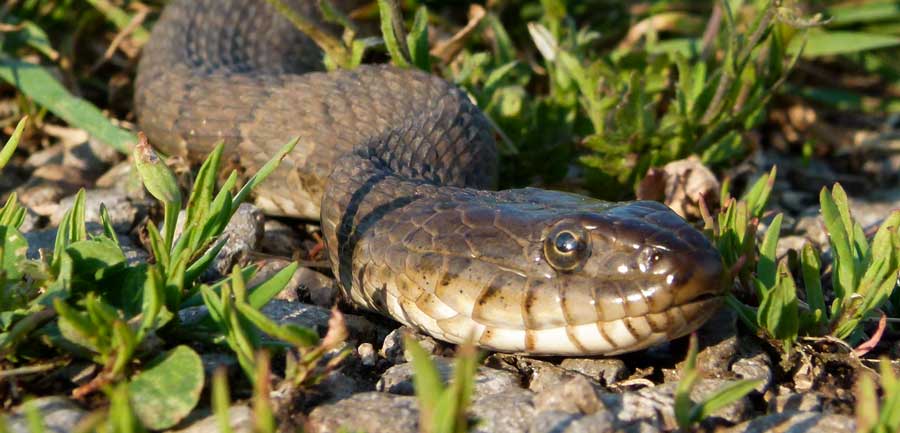 Passing visitor. We always called them black snakes but I think it’s a northern watersnake. They come out of hibernation in the spring, lay about sluggishly, then head for the water for a happy summer of scoffing down yummy fish and frogs. They’re very hard to see among gravel and leaves and they opt for imitating dead sticks rather than skittering off like garter snakes. They’re harmless, of course, but can give you a turn when they swim up to you in the lake to see if you are edible or at least a floating log where they can bask. They happily swim miles from shore and dive ten feet down if there’s any prospect of a meal. I’m so pleased this one paused to smile for the camera.