Blog

The Big Thaw. When We Should Be Shivering

It’s February. 

We had snow, we had ice, we had wind and now, suddenly the temperature has shot up.  Nine degrees Celsius, 11C, now 14C. It might as well be April. In a week going from bucking the car through snow to slopping through puddles and squidgy soft mud.  The maple syrup has started running early so we have to make sure not to miss Maple in the County, the weekend we can all stuff ourselves at the sugar shacks with pancakes and sausages slathered with as much maple syrup and butter as we can load on.

One week covered with ice and snow.

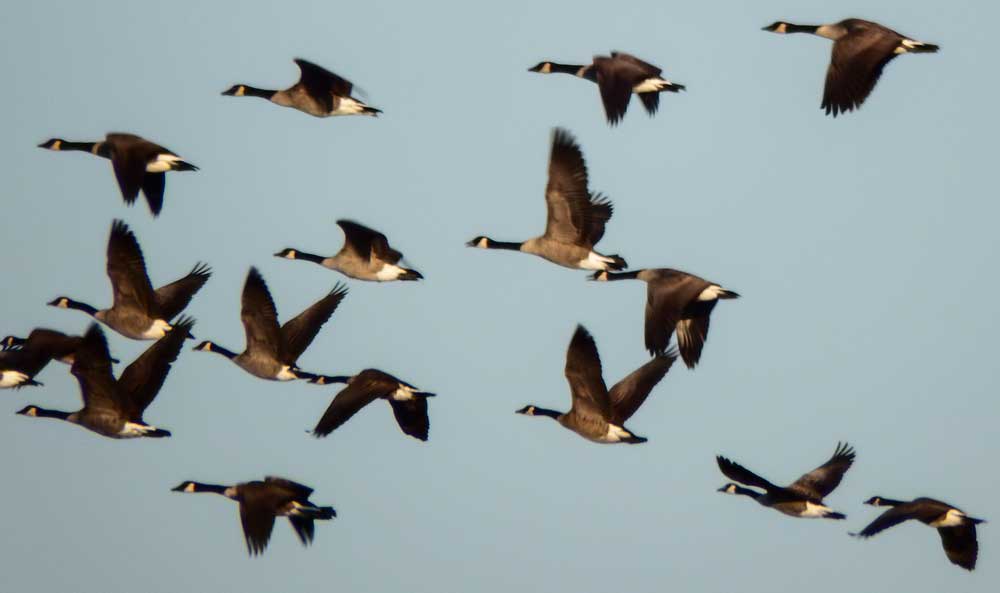
The geese are flying north in squadrons and now there is a contingent standing around on the slushy pond ice  in the field hoping for a swim which might come sooner than they think.  Another band has landed in the pasture nearby, poking hopefully about for something green to devour. Robins are appearing, though there hardy sorts that stay around all winter, eating seeds and berries instead of unreachable frozen worms. The squirrels are getting frisky, chasing each other from tree to tree probably in romantic pursuit. Indoors, the cats have also started galloping about and pressing their little wistful faces against the glass doors wishing they could go out.  I wish they could too but there are fishers, hawks, foxes, coyotes, wolves, even a pair of eagles  not to mention the road zooming with speed demon, cat squishing drivers. It’s hungry season out there.  To stay alive, they stay inside.

Next week its balmy time. Snow all gone. Temperature masquerading as April.

Disappearing roadside snowbanks reveal the things tossed from cars including coffee cups, beer cans and booze bottles.  The entomologists tell us that the insects parading up the window panes are here to stay. The first of the spandex clad cyclists have already flashed past, their bikes out of storage, their ambitions brightly on view.

But, it’s still February! Traditionally, the coldest days of the summer are in this month, into the minus 20sC. We supposed to be worrying about our wells freezing and our mailboxes buried in snow. Some of the best logging has been in March when winter thick ice supports skidders in all the swampy places.  Yet folks are out in shorts and running shoes. 

Just a whim of mother nature?  Or climate change?  Hmmmmm…..


New England Vampire Panic, A Tale We Can’t Pass Up

A poke through the internet looking up, say, best prices on a vampire killing kit for a safe vacation, lets one stumble upon the most curious information.  This time about  the great New England vampire panic of the 1800s.

Vampirish beliefs have been around since the dawn of time and New England did not escape. It wasn’t the Bram Stoker cloaked figures sucking blood from jugulars that manifested. A more amorphous belief took hold, a conviction that some of the dead were not quite dead. Somehow the dearly departed were sticking around to suck life out of the living. 

And they had to be stopped.

At the time, this was a perfectly logical response to the outbreaks of tuberculosis that laid waste to whole families and communities once it got going.

Tuberculosis was known as consumption, a particularly apt name for a mysterious ailment that literally consumed a victim. One member of a healthy, active family would suddenly begin to weaken and, over period of agonized, hope in assorted ineffective “cures”, the person would become emaciated and finally die.  After a while another member of the family would similarly sicken and fade away. Then another and another. No treatment, including sugar water, bites from rattlesnakes and lots of horseback riding, had any effect.

So what was causing folks to waste away so alarmingly.  Could it be that those who had gone before were in some mysterious way still lingering to leach life from those still alive?

It was as good an explanation as any other.

The idea took hold.  Panic arose to make sure those in the graveyard were really dead and not rising to mooch vigor from their above ground fellows. The accepted method was to exhume the body and employ various squelching methods ranging from flipping the corpse upside down,beheading, binding with thorns.  Poplar was ripping out the heart, if the corpse still had one, and burning it, sometimes as a public spectacle.  Inhaling the smoke of the burning heart was supposed to be a cure.

Often the people doing the exhuming and corpse scrambling would be the actual family and friends of the deceased. That could only mean true desperation to escape a dread disease. Though this was often done on the sly, there are thought to be hundreds of cases scattered about New England as folks did their best to protect health and safety just as we do today.

Sufferers had to wait for a real cure until the nineteen forties.

Read all the details in the terrific article in the Smithsonian magazine.

Then just check to make sure your own life essence isn’t being surreptitiously slurped up when you aren’t paying attention.


Positively the Last Word About the Road. Until Spring.

Orange anchor bags of sand left on the verge.

I thought I was finished with the road paving project but I’ll have to mention those annoying little leftovers after the road was paved. The dump truck came, the crew marched along picking up the road markers, the construction signs and the bright turquoise portable toilet. Done, I thought, but no.  A hike down the paved stretch turns up all sort of things they missed.  The grass yielded up a abandoned spray can full of bright orange paint.  Orange bags of sand for anchoring signs lie on the road verges.  The stakes first driven in by the roadside with mysterious numbers written on them remain at their intervals, some now suffering from the snowplow.

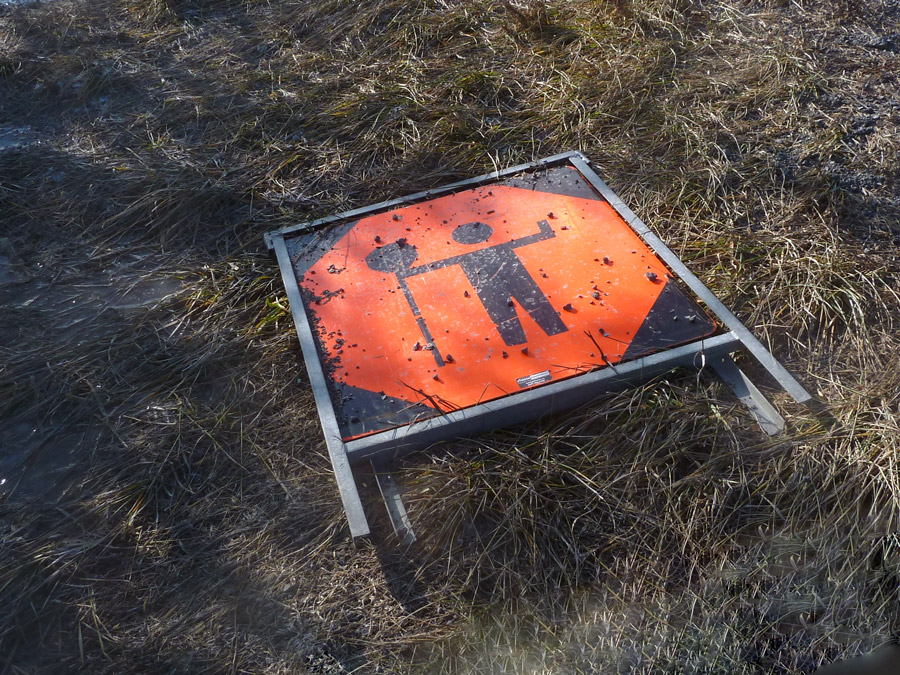
Among the odder items is a cardboard box containing asphalt that turned rock hard as soon as it cooled. This box, like a gift, has been left by my fence with its inflexible contents, so far impervious to rain and snow and wind.  Perhaps, in time, the cardboard will crumble away, leaving me with a tidy black square to decorate my roadside and puzzle passersby.  The fresh gravel shoulders laid down so neatly are being scattered in broad sprays by the snowplow. Perhaps that’s how road shoulders get smoothed out.  Some leftovers are big misses, such as entire constructions signs complete with metal frames and legs.  Perhaps they’ll wonder why their sign count is short back at the storage sheds.

Measuring stake snowplow casualty.

This is just a little chuckle about a certain lack of tidiness generated by the paving project.  The worst leftover, of course, is the roughly patched paving mistakes we have to bump over until they come, as they say, to put in another surface layer in the spring.

All of this finally prompted a brief internet inquiry into how hot mix asphalt is created.  Very carefully, I take it.  The mix is 95% gravel, rock, recycled old paving, etc. and 5% crude oil byproduct. It must mixed and heated to exactly the right temperature at the plant to move easily through the paving machines and flatten smoothly under the rollers before it hardens.  The temperature has to be correctly calculated according to the season and the distance the trucks have to travel to the paving site.  Too cold or too hot and there will be too little or too much air in the pavement, causing the pavement to buckle or break.  Nor can there be any water in the mix. Imagine miscalculating time and having the stuff harden in the truck.

Box of asphalt by the fence. Very odd.

I had no idea paving was such a tricky process. Now I truly sympathize with whoever cleans out the paving machines at the end of the day and can certainly forgive a little untidiness as the crews thankfully go home from a job a lot more complicated than it looks.

Road Paving Finished at Last. For Now.

Paving mistakes. Patched for the winter.

After the pavement in front of the house was done, the machines disappeared far down the road and busied themselves on a stretch out of my sight.  Finally hiked down after the crews had gone home.  Ooooh, the paving machine had gone off its game for a quarter mile.  Heavy tires had sunk through the fresh asphalt.  The crew had been busy all day filling in ruts and scrambling to fix the damage. A series of long, lumpy patches marred the velvety smoothness of the new pavement. The illusion of perfection was broken, drivers shook as tires bumped and rumbled over the rough edges.

However, my section is lovely. And the next step was installing a shoulder band of crushed gravel to exact width and depth so as to look like fine grey edging on a handsome evening cloak.  Unfortunately, I was in town for the day and missed seeing how they got it all so precise.  I also wondered why random daubs of white paint appeared down the centre of the road as though someone had dashed along with a paintbrush flicking paint as they ran. 

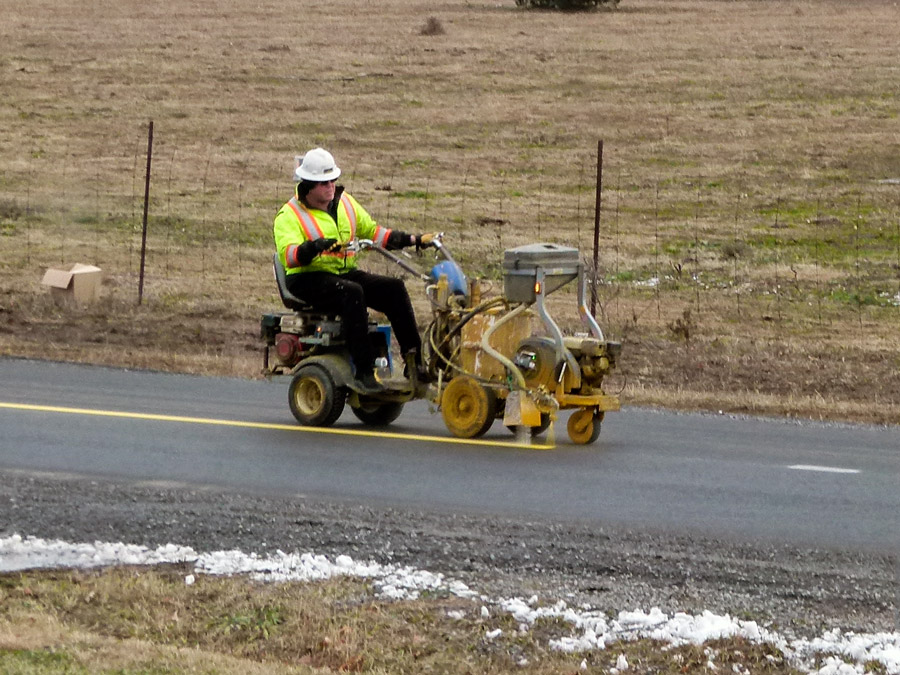
Turned out, the daubs were but guides for the strange machine that appeared next.  A workman in hard hat and boots drove along the middle of the road in what was looked very much like a motorized scooter.  This scooter was escorted by a pickup truck warning off traffic.  As this little contraption putted along, a small spray head sprayed yellow paint in a solid yellow line.  The spray head followed the white daubs, covering them over and only showing a slight wobble a the skilled driver kept to the daubs.

Refilling the little yellow stripe machine.

So, with the flourish of the yellow stripe, the road was done for the year.  I knew that when, at last, a dump trunk showed up to collect all the road warning markers and, the final confirmation, a fellow loaded the portable toilet onto a pickup and drove off along the new road complete with yellow line, neat gravel shoulders and smooth, smooth driving.  Left behind are only the stakes driven in at intervals with their mysterious numbers, a couple of cardboard boxes containing, of all things, leftover rock hard asphalt. 

Oh, and and the jarring, disfiguring patches.

No worries, the road men say.  They intend to return next year and cover all flaws with a whole new layer of paving.  Can’t wait!

Glorious yellow stripe. Brand new pavement too. Zowee!

Bye, bye visiting toilet. See you next year.

Asphalt Time. Weather Warms. Paving Finally Begins.

After a week of snow and cold, the weather gods relented.  The sun came out. The road crew reappeared.  I wonder if they enjoyed a week of leisure with their feet up before getting the call again. Something tells me not likely.

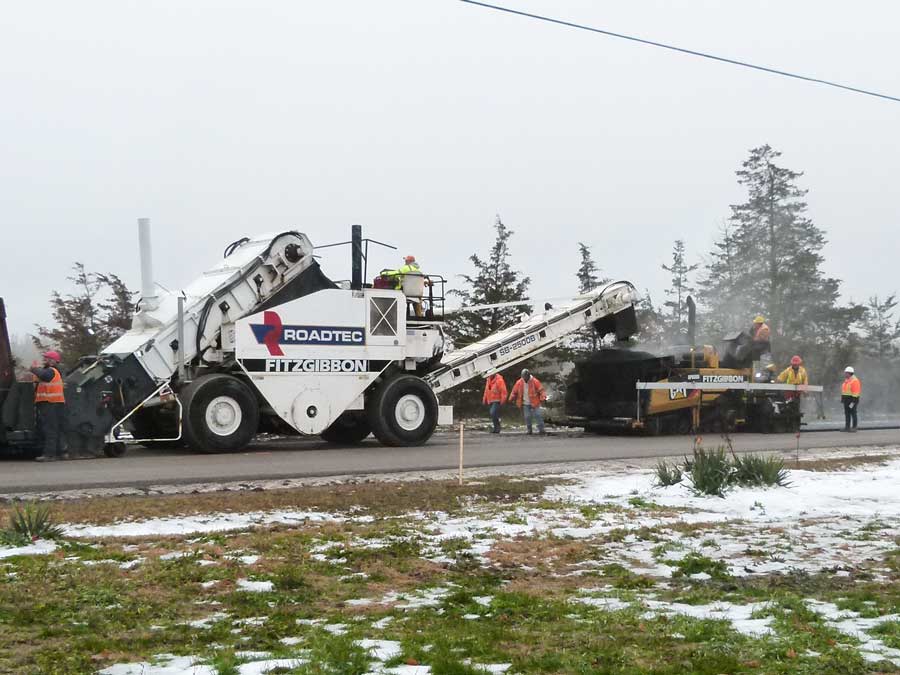
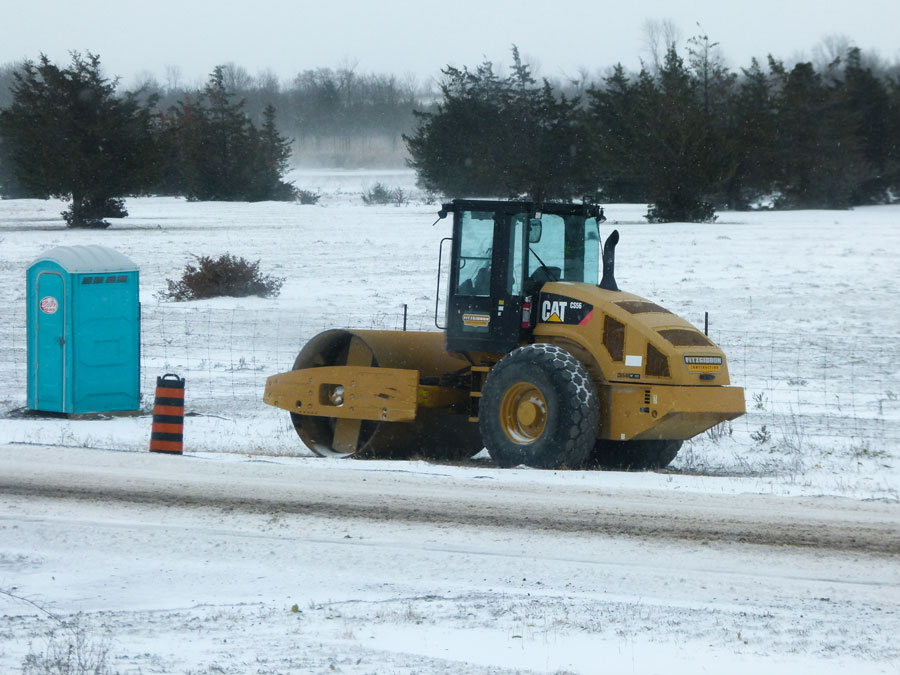
Anyway, once again the pickup trucks pulled in before dawn and the crew swarmed like ants over the great machines which were silent no longer.  The deep RRRR of engines starting up pierced the morning solitude. The rollers and the huge white RoadTec monster rumbled to life, their warning lights starting to flash, their keepers inspecting them all over in case they come to some harm during their dormancy.

This slideshow requires JavaScript.

So the process began. The long necked white RoadTec machine lumbered out onto the road and along to the end of the stretch  to be paved, followed by the rollers and a yellow beast, again of mysterious function. I waited for them to reach my territory. They came in order. First a flock of dump trucks lined up for the privilege of dumping their loads of hot asphalt, one after the other, into the front maw of the RoadTec which, I was told, can store tons and tons of the stuff in its innards. 

The RoadTec chugged out the asphalt in a regular stream from its long chute at the back.  The asphalt then entered the gaping mouth of the yellow machine which did the actual paving.  For out the back it laid a flat layer of pavement one lane wide.  And behind the paving machine came the rollers, rolling the asphalt compact and smooth while it still steamed with heat.  For once cooled, the asphalt becomes hard and rigid, permanently keeping every lump, bump and dip not tended to by the rollers in time.

So that was the day’s excitement.  The parade of paving equipment, as coordinated as a ballet troupe, inching its way down one side of the road in the morning and back up the other side in the afternoon.  There is now beautiful black velvet smooth road in front of the house with not a mark on it as yet. The dinosaurs are parked, the crew vanished away in the creeping dusk. The flying mud is sealed over. Passing cars can’t believe their luck and I now know how a road gets paved.

There are many finishing touches yet to come.  What will they be?  Stayed tuned.

Winter’s First Strike. Paving Screeches to a Halt

With the road all ground up and flattened and graded gravelly smooth on a Friday afternoon, it seemed a sure thing for the asphalt to start going on top Monday morning. After all, Friday was almost 14C and the construction guys were going about in shirt sleeves.

Ha!  Not so.

Over the weekend the temperature plunged below freezing, the clouds lowered and glowered, leaves blackened and strange white dots began flying past the windows.

Something distant memory recognized as snow!

pavsnow2

Plunging temperature, first snow, forlorn machines and a muddy road.

The season flipped from balmy to winter. Cold set in, the wind set in, the white stuff covered the ground and did not disappear. Soon, the road itself was white. And, shocking to see, the first sand and salt truck of the season lumbered past spreading a brown stream of traction out behind.

Were the pavers going to pave over snow?  Apparently not.  Monday morning rolled around. No crews arrived before sunup to climb over the machines and warm up the throbbing engines in the half dark. No indeed.  No sign of movement at all.  The rollers, the graders, the long necked white RoadTec machine sat in silence, like abandoned dinosaurs.  All day no one came near them.

All week no one came near them.

The  snow stayed, the  salted road turned into a slurry of liquid mud that flew up and coated every vehicle that drove past, blotting back windows and spewing grittily over the sides.

So have the pavers sadly miscalculated the weather and failed to beat winter? Did they start something they can’t finish?  Are we who live on the road condemned to a winter of spraying mud and rough gravel shakes if we want to go to town?

All of us wait anxiously to see.

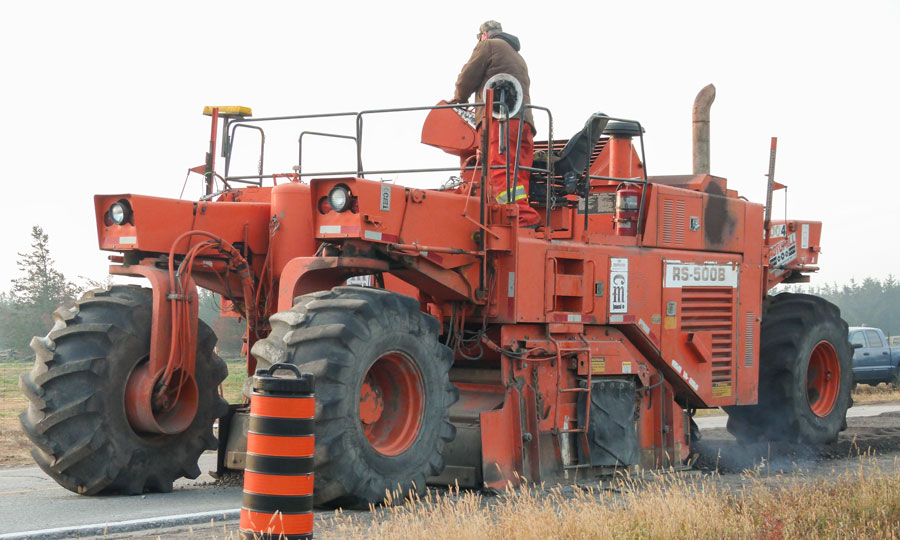
Bye, Bye Old Pavement. Orange Monster Will Eat You Up

For a quick education in how an old road is made ready for the new, I just had to look out the window.

pavorange2

Orange monster chewing up pavement and leaving a thick layer of ground up asphalt behind.

The massive orange monster pulled out and lumbered on up the road toward the beginning, I presume, of the work stretch.  Later in the day, I began to hear a rumbling. Then a roaring, then a deep throaty grind as though something had decided to chew on the very bedrock we stood upon.   Eventually, a broad orange snout came into view, followed by the rest of the creature.  Inching along, barely appearing to move, the monster inexorably crept forward, devouring the old pavement in front of it, leaving behind a broad, thick swathe of loose, ground up asphalt which looked like a neatly laid gravel bed. Inside the stout steel guards curtaining round the part where the monster bit into the road, there must have been great rolls of grinding teeth too terrible for public view.

So that’s how it’s done with nary a dump truck needed.

After the monster follow the graders and rollers, like attendant servants, worked the ground up asphalt into a smooth, hard surface much like the few gravel roads still found in the backwoods. As the hungry behemoth rolled, only one lane of traffic remained open. At each end of the work stretch stood the familiar fellow holding the “Stop” sign with “Slow” on the other side. In between another lucky dude had the job of driving a pickup truck back and forth all day, each time leading an obedient file of cars safely past the monster and the graders in the single open lane.

pavgrader

Grader right behind the monster smoothing out the road so folk can drive on it

The orange monster slowly crawled from sight.  Then, much later, appeared again, this time grinding up the opposite lane.  When it had finally passed, the rollers set to work in earnest, joined by two graders, all bent on finessing the road surface into a kind of ballroom levelness that sported no dip or hollow. They weren’t satisfied until quitting time when the crews went home, leaving us with a nubbled  surface spitting up dust and pebbles at passing cars.

The pavement chewer boarded the huge truck that hauled it and went home too. It can sleep, dreaming of its day long asphalt feast. I look at the gravel road and hope we won’t be left to drive on its dusty, stony back all winter.


Surprise, Surprise! They’re Going To Pave the Road

pavsigns

Construction signs in waiting.

Yes, it’s a big deal.  The road past the house has been prolific mother to potholes and scaling off chunks of asphalt into the ditches for years.  It is uneven and has developed long grooves where the traffic rumbles along. We just live with it and envy the velvety new pavement that extends from the village’s new bridge and stops a mile short of the house.

pavstake

Stakes bearing cryptic numbers along the road.

Until, one day, a notice is slipped into the mailbox.  Please pardon the inconvenience but work on the road begins in a week.  Lightning speed for construction in my neighbourhood. If I needed further proof, a pile of orange construction signs appeared in the ditch next to the fence.  Looks like I have a front row seat for everything.

pavmarker

Ceremonial placing of marker cones.

So far, a fellow in an orange vest has marched down the road, pushing a small wheel on a stick. In his wake, spray painted numbers on the asphalt and tall stakes driven in beside the marks with numerals only the initiated can decipher.

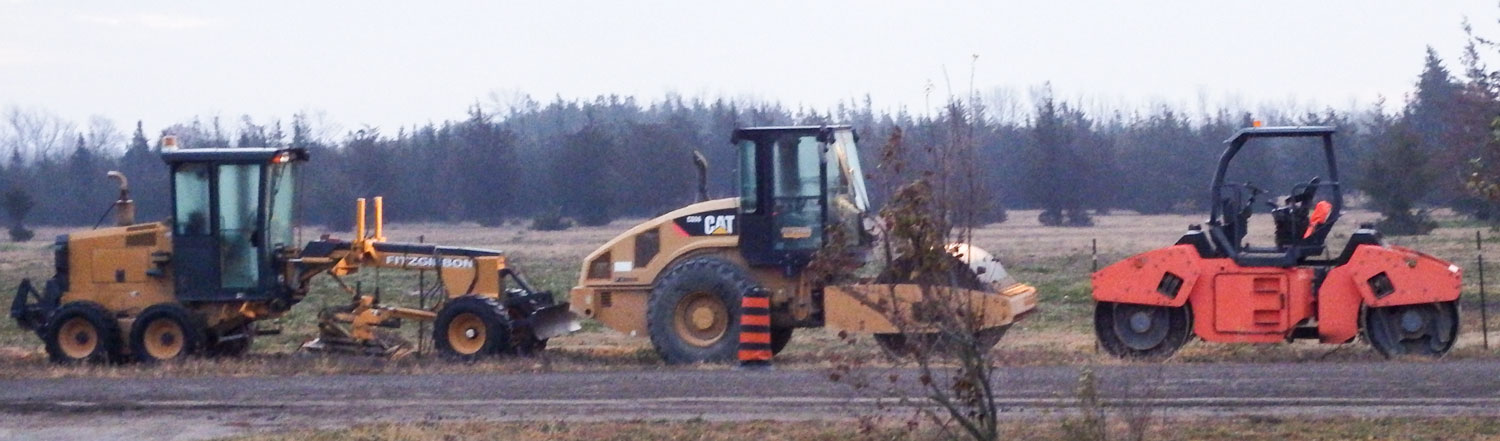
On the morning after the march, the big machines started rolling in, unloaded from floats and parked in the wide, flat ditch across from my barn. Turns out, I have the best parking spot along the entire stretch slated for improvement.  Two rollers, a grader, a huge white machine with a long neck like a brontosaurus and another orange monster with tires as tall as me and steel shields beneath it reaching to the ground. No hint as to what it might do.

pavpotty

Arrival of the portable toilet. A work crew must really be coming.

And that sure sign of a construction site, the arrival of a bright turquoise portable toilet right across from my windows.

Now even more excitement with the placing of orange and black cones on the road.

Action is building. Stayed tuned to see what happens next.


Road Kill: Yuck for Us, Bonus Feast for the Coyotes

Yeah, we all look away when driving past the latest furry casualty. Death on the road can be a messy business and just about all of us are guilty of adding to the carnage. Those dizzy squirrels that can’t make up their minds and those bunnies with a death wish that shoot right under our wheels. I’ve heard a skunk actually explode underneath me a millisecond after it insisted on bolting to its doom.

Roadkill, however, is a valued part of the food chain my part of the woods.  There’s all those turkey vultures to support, the crows and ravens, coyotes, foxes, weasels and fishers.  The noble bald eagles, which have recently favoured us with a return to the region, turn out to be scavengers in search of washed up fish or whatever else conveniently deceased they happen upon.

People also get in on the bounty. The home care worker who used to visit my old dad told us she did so much driving that she had hit a total of six deer in her travels.  She simply stopped, flung the deer in the back of her truck and took it home for her husband to skin, cut up and stow in the freezer. Free venison for the winter.

deerhead

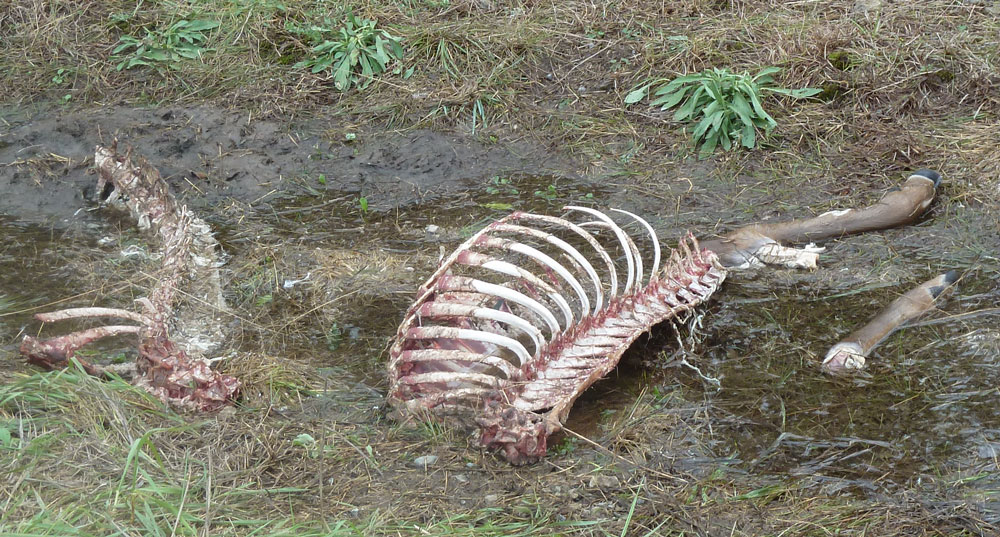
Deer head and neck. Where’s the rest of it?

Out biking this week, I came across the head and neck of a deer on our back road. Most puzzling since deer usually have four legs and fluffy tail attached. So I ventured to peep in the ditch behind the long grass of the road edge. 

There lay the rest of the deer, stripped clean already, reduced to a white skeleton with only the bare bones and inedible shins left to be seen. That meant there had been a joyful feast for the coyotes the night before.  The whole neighbourhood must have been invited to devour every scrap right down to the ribs and vertebrae. They must have done it stealthily, melting to invisibility when a car drove past in the dark. Nor did they touch the head which would have taken them onto the open road and into danger themselves.  Organized, clever, efficient. And they probably don’t have to hunt for a week afterward. 

Most roadkill can’t be helped and nature always recycles. If you hit a moose, it’s you that’s likely to be the roadkill. And if you are one of those vicious, slime covered, brain dead unspeakables who deliberately aim at turtles crossing the road, you deserve to join the turtle on the pavement.


Discovering the Local Photo Club. An Excuse to Mess About with Photoshop.

This fall, I discovered and joined the local photography club and found my fun. I am a rank amateur so I take to the organized outings, challenges and required contributions to the monthly slide shows. Now I have structure and a reason to keep on snapping.  The club is sprinkled with pro photographers, graphic design people and so on who have been tempted to the county to retire.  However, the point and shoot camera folk are also very welcome.  The meetings are crammed with avid listeners.  Perhaps this is my niche.

gailhamiltoncruisenight-arrivaloriginal

Antique car in mall parking lot.

gailhamiltoncruisenight-arrivalzliscense

Female trouble arriving for smug folks in the big house.

Between the slide shows of member photos, there are speakers on various topics, way above my head.  Infrared photography: you can get the manufacturer to convert your current camera to an infrared camera for about $600.  Photographing stars and galaxies: Nikon, Canon, etc. produce special cameras for this purpose. Who knew!  You can get a tripod head that moves your camera at sidereal speed so there are no light trails.  If you are doing a small part of a distant galaxy, you fix a camera on a star in that galaxy via a telescope and that camera will obligingly send messages to control your other camera all night long. Phew!  Then there is the processing of these hours of photography.  The speaker, just back from the Atacama Desert in Chile (driest place on earth with telescopes and good restaurants) said it took him 13 years to truly get the hang of it. I guess so!

gailhamiltoncruisenightoriginalfog

Antique car in parking lot. Needs a polish.

gailhamiltoncruisenightmistliscense

Any minute some gangster is gonna pump you full of hot lead.

And who knew just printing a photo could be so complex.  You can buy a $600 widget to sync your printer’s colour range with that of your photo software on the computer.  And you never use photo paper from any old place, like Staples.  You order directly from the printer’s manufacturer specifically for your printer.  For best results, go to a professional.

gailhamiltoncruisenightphantomoriginal

Antique car with hood up. Boring!

gailhamiltoncruisenightphantom

Her ghost will never leave the car that carried off her darlings. The new owner is in for a shock.

I’m unlikely to take up infrared or sidereal photography or possess the awesome equipment I’ve seen toted around on outings.  My humble bridge camera does just fine for now.  I’m chugging through Ben Long’s excellent Foundations of Photography online course on lynda.com (free via the public library) which finally enlightened me about how a camera actually works. I learned about the early Renaissance “camera obscura” in which a pinhole in a blocked window would project the street outside upside down on an inner wall. Artists then painted along the lines and astonished folks with the accuracy of their street scene.  So “camera” actually means “room”. Which has entirely changed my ideas of what politicians were doing when consulting “in camera”.

gailhamiltoncruisenighthoodoriginal

Yet another classic asleep in the parking lot.

gailhamiltoncruisenighthood

Hey, is that the sixties on the horizon? Let’s mix a little moonshine with these funny yellow pills.

Mostly, I just want to mess around with Photoshop, which I’m not sure is approved of by the purists, and I need photos for the mix.  Beautifully shot scenes in natural light are all well and good but I like something going on in picture. The meddler in me seems determined to insert some kind of movement, some kind of story to make the thing interesting. Isn’t that why Normal Rockwell is so universally loved? Each of his paintings is really a flash narrative that goes straight for the heart.  I want in on the action too.