Don’t miss Magical Love, coming out on February 11, just in time for Valentine’s Day.
The book hatched when I began wondering how a true nerd scientist, struck by the mating urge, would get women to notice him. Scientifically, of course. Jason invents a modern day “love potion”, a carefully formulated chemical concoction designed to irresistibly attract the opposite sex.
Well, you can just image what a storm of havoc that lets loose. Unwittingly, Jason falls for one of his test subjects, only to realize he may be the first victim of his own meddling with nature. What but disaster can result when the “potion” is cut off!
Backpedaling frantically, Jason races to destroy every drop of his love-enhancer before it breaks more hearts than his. He is too late. The “potion” has already brought its whirlwind effect into lives of two more couples.
Magical Love follows all three through the often hilarious ups and downs of romance on chemical assist.
You can pre-order Magical Love right now from Amazon.com.
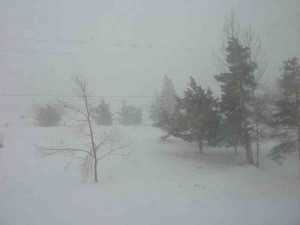
Raging snowstorm, freezing winds. Requires six layers of clothing or our own coat of fur–if only we had one. Which would you choose?
It’s f-f-freezing out! Howling winds, driving snow bring us frostbitten noses, stinging cheeks, icy feet, shivering bodies. All while coyotes trot by, the bunnies cavort and the polar bears stroll through Arctic blizzards with cheery unconcern.
These creatures have thick warm fur coats while the humans living beside them are hatched bare as goose eggs. Without clothes, we die of hypothermia quick as grasshoppers tossed out into the storm. It makes no sense.
Why don’t we humans have fur too?
It’s an evolution thing, the scientists say. We evolved on the African plains where fur was just an impediment to keeping cool. We copied the elephant, the rhino, the hippo, who also dispensed with a hairy pelt in the interests of air conditioning. Or we may have had some semi-aquatic stage when we imitated the naked hides of the walrus and the dolphin before changing our minds and heading back to land.
Whatever expedient decisions our ancestors made about the benefits of hairlessness, it’s long past time for an update. We’ve been away from the African plains for thousands of years. We’ve spread over Russia, Scandinavia, Alaska, Alberta, Saskatchewan, Labrador, Quebec and Minnesota. When is evolution going to kick in again, helping us grow a magnificent coat of fur like that of the bears and wolves, caribou and wolverines, husky dogs or even the tabby cat?
Imagine the joys of being actually adapted to our climate.
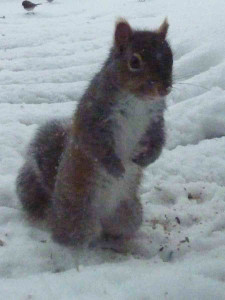
Squirrel laughing at us for being hairless wimps in the cold.
To step outside in comfort without parkas, boots, scarves, mitts and three pairs of woolly socks. Only wearing our own coat of fluffy winter fur. Clothing would become irrelevant. (What a saving!) Home heating bills would plummet. Fur conditioners would become big business along with super vacuums for when we shed in the spring.
So come on, Mother Nature, hurry up with the adaptations. We’re tired of shivering as the naked ape. Can’t you make us at least as well insulated as those warm-coated squirrels smirking at us as they leap merrily through the snow?
For the first time ever our bridge has its own lights. Wide modern black bells hung from sturdy metal poles finish off this three month construction project. The poles come optimistically equipped for festivities. Horizontal arms stretch out waiting for the banners and flags of future festivals, celebrations, maybe a good old foot stomping roust up.
Perhaps they are also a nod to the parades, Fair days (when we still had a Demorestville Fair) concerts, amateur shows, brass band marches, and Arbour Day processions that once livened the village.
I can’t wait for the first new banner to go up — a sure sign that the party isn’t over yet.
Wind hits hard around here. We had one of our autumn windstorms a few days ago. Gusts to over 100k, bringing down trees and hydro lines, picking bits off roofs and pushing cars about on the road.
But it couldn’t take out the abandoned robin’s nest in the yard.
This bunch of dry twigs, perched precariously on a skinny branch in a skinny tree, sat exposed to the full blast of the gale. Dead leaves shot by like missiles and the treetops whipped wildly. The nest never budged an inch.
That robin really understands architecture. She waits for a rain then anchors the nest with beakfulls of mud into which twigs and grasses are skillfully woven and cemented with more mud. It may take few hundred trips to create the bowl that looks like light grass but is hardened inside enough to ride out a hurricane. The finishing touch, of course, is an interior lined with the softest grass and hair soft to cradle the delicate blue eggs and just fit mamma. Comfort and security at their very best.
I don’t get sick much and generally don’t bother doctors. However, like a great, invisible bulwark behind me, I know that Canada’s health care system is there should I need it.
My first serious illness was a few years ago when I was immobilized by what I imagined was a really bad cold. When I finally dragged myself to the ER, I was diagnosed with bacterial pneumonia and admitted immediately. I spent nine days in the hospital receiving the best of care. When I was released, my total bill was $9 for phone rental.
This year, when afflicted with fuzzy vision, the eye doctor informed me I had a cataract and should get it fixed. I dutifully got myself into the queue for cataract surgery and, almost before I knew it, I was fitted out with a brand new eye lens giving me a crystal clear view of the world around me. All this was provided, free of charge, by Canada’s universal health care plan.
Of course it isn’t free. We all pay for it through our taxes and I, for one, am very glad to do so. I can’t imagine having to worry about affording personal health insurance or avoiding the doctor because I couldn’t scrape together the insurance deductible. Or worse, watching some monster health corporation suck up my last penny because I needed medical care at life’s end.
Yes, a modern health care system is expensive to run and ours has its issues. But how much better to bear the cost together, as a caring community, rather than abandon individuals to pay up with everything they have in order to get desperately needed treatment. How horrifying to lie ill in a hospital bed and be regarded as a source of profit. To be torn between an institution running up the bill and an insurance company bent on protecting its own bottom line.
Canada’s universal health care is a major pillar of economic and social stability. It attracts business and industry because companies do not have to deal with medical coverage. It frees workers to move from job to job without fear of losing a health plan. It is essential in keeping our societal fabric in balance, safe from extremes of poverty caused by untreated sickness and medical debt. It lets hard-earned family assets pass on to boost the next generation instead of draining inheritances into the pockets of medical corporations. It costs significantly less per capita than the US system to our south and remains a bargain to the nation. Like education and the vote, decent health care is available to all.
It gives each of us indescribable peace of mind.
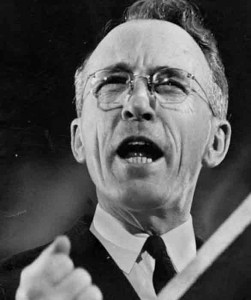
Tommy Douglas: “My friends, watch out for the little fellow with an idea.”
This public health care system was begun half a century ago by Tommy Douglas, the idealistic premier of one of our most unnoticed and underpopulated provinces, Saskatchewan, a place that had little but wheat and wind.
As a preacher during the Depression, Tommy had witnessed unspeakable suffering in families that could not afford doctors. Determined that no one, regardless of circumstances, should go without medical care, he went into politics and courageously fought the whole for-profit medical establishment to a standstill. His party did not budge even in the face of a doctors’ strike and vicious, massively funded anti-medicare propaganda that poured outrageous lies into every home. The people still chose Tommy’s compassionate health care plan.
And, guess what — in a recent nation-wide vote to decide who is the greatest Canadian, this scrawny, long-dead politician won, hands down, beating out inventors, sports icons, scientists, Prime Ministers, a Nobel laureate and even our nation’s founder.
Eventually frost will freeze the collards into ice sculptures and turn potatoes and beets and apples into rock balls. That’s when our beloved local vegetable stand will finally have to close. So far, it’s managing to last into mid November even though the chill wind whips through, requiring mitts, toque, scarf and toasty coat to stick it out at the cash register.
The place is still busy with local customers and shows off its bushels of brilliant bounty. Cabbages, red and green peppers, heritage apples, beets, brussels sprouts, yams, kale purple cauliflower, every kind of squash by the bushel and, until a week or so ago, sweet corn. The family has run the farm for over 100 years and regularly clean up the prizes at the county fair. There are sheep in a pen for kids to pet, tame rabbits hopping about underfoot, a old dog watching the cars come and go.
By the bushel and wagon load
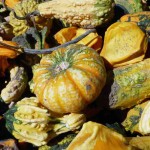
Heaps of variety
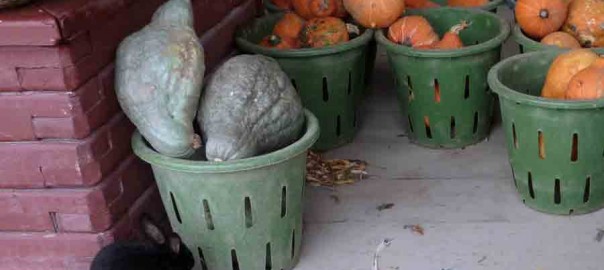
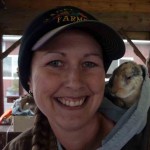
Popsicle the bunny keeping Sarah warm
Pyramids of peppers
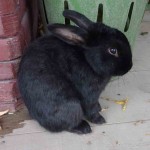
Midnight is my name, relaxing is my game
Baskets and baskets grown only a field away.
In high summer, the tractors and ATV’s race back and forth to the fields for more produce, leaving muddy tracks across the highway, as the tourist s swarm in. The rich sandy loam on which Picton is founded turns out fruit and vegetables by the wagon load. From the first greens of spring, we have all been able to eat out the stand and escape the apples and garlic and hordes of other edibles shipped from China.
It’s going to be -4 C in a couple of nights. Fingers crossed that the heavy sheets thrown over the vegetable opulence at night will be able to fend off the effects. Another week, we ask. And after that, another. Maybe. If the frost giant will hold off. If not, then thank you, thank you, thank you until next spring.
Chill wind, chill rain, morning glory leaves shrinking at the first touch of frost. After her long sleep through the summer inside her cold black stove, it is time to awaken the fire goddess. I need to keep warm for the winter.
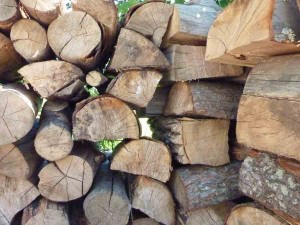
Though sweltering in August, I never forgot her. I laid in and stacked four cords of wood, maple and oak, to feed her endless appetite. The chimney is newly cleaned, the stove swept out and cracked firebricks replaced. Now there’s little sun to start my solar panel pumping heat. The house gets too chilly for another fleece shirt. It’s time to give her a prod.
The first time is always a ritual, The base of small sticks laid out on the ash-free bricks, the pyramid of scrunched up newspaper, old cardboard, twigs and kindling. the heavy blocks set in at each side to contain the infant blaze. The first match, the first tiny flame, then the whoosh of dry newspaper flaring high, then dying as quickly while I hope the kindling has had time to catch. Sometimes it take two of three more tries before the slivers of wood decide to keep the little flames going. The fire goddess takes her time, showing me she wakes at her own leisure.
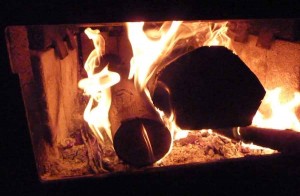
She relents at last. Kindling begins to burn so I pile more on until I feel the flickers will not die again should I turn away. Lastly, I grow confident enough to put another block on top of the kindling so that the new fire is now enclosed on all sides, something it seems to like very much. I close the door and through the polished glass, I see the flames grow stronger, lick under the side blocks and engulf the top block in a hungry stream of orange.
I smile — and imagine the fire goddess smiles back. She is fully awake now and stretching herself inside her iron home. The best of friends, we will co-habit cheerily when the snows blow in. But I have still changed the batteries in the smoke alarms. I also know she will not pass up any chance to get out of hand.
A fine fall morning reveals a host of tiny cobwebs in the roadside white clover. Up close, they are filled with glittering drops of dew, delicate tapestries of miniature crystal.
Dozens of spiders must have laboured through the night, hoping to catch their breakfasts. I hope they were successful because, by afternoon, not a trace of spiders or webs are to be found in the clover.
Morning work of art.
So where have all the spiders gone? And how do they feel about having start all over again spinning their nets against the forces of dew and wind? I bet they are wearing silently to themselves in spider curses.
Even among the roadside weeds some advanced labour efficiencies are sorely needed.
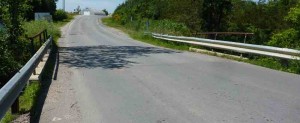
After all the waiting, our little village bridge is done. All the finishing touches have been put on, the orange pilons are gone, the flashing signboards warning of closure and loose gravel are lined up at the side ready to be hauled away. A new sign points to destinations north and south lest anyone is confused about where they are going. It also points out camping grounds and how to find our esteemed local kayak manufacturers.
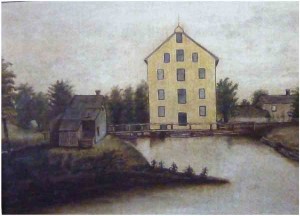
Early wooden bridge in same place with six-storey mill and former mill pond.
Brand new white lines keep us in our lane and show us exactly where to stop so we can spot traffic speeding up the hill below. Generous shoulders will please bike riders and village folk out for a stroll. Vast stretches of shining safety rail, much more than before, ensure we won’t slide into the deep ditch in the winter and shepherd us into the conservation area at the side. Our sweep of new pavement even has it’s first fast food litter decorating its edge.
Preserved wall fragment, all that’s left of the great mill which was once one of the largest in the country. The mill burned down spectacularly in 1909.
No longer the teams and wagons picking their way nervously over the first narrow plank crossing by the mill pond. Eighteen wheelers can roar up the hill without a blink. Guillaume Demorest would be astonished. And proud that his rushing creek and quiet village manage to renew themselves over 200 hundred years since he first found the waterfall and declared he would stay. Wonder how the bridge will look 200 years from now.
 Don’t miss Magical Love, coming out on February 11, just in time for Valentine’s Day.